

Sustainable packaging bags that meet European standards need three things: verified certs (REACH, OEKO-TEX, GOTS), traceable production, and a supplier willing to hand over test reports. Not a sales brochure. If you're sourcing for Europe, vague "eco-friendly" labels won't cut it. Not anymore.
We've watched containers get held at European ports. The reason? A supplier's green claim didn't survive a customs check. After 40+ years of making jute and cotton bags for 20+ countries, we've seen every shortcut. Relabeled products. Borrowed certs. Dye processes that wouldn't pass REACH screening.
This guide comes from the factory floor, not a marketing desk. We'll cover which materials work, which certs European customs care about, and how to vet a supplier before you spend a single euro. According to Towards Packaging's 2025 market report, the European sustainable packaging market will hit USD 216 billion by 2035. Where there's that much money, there's that much greenwashing.
What Makes a Packaging Bag Truly Sustainable
(Not Just Marketed That Way)
A truly sustainable bag hits four marks. It uses renewed or recycled stuff. It's made under verified green and ethical rules. It's built for reuse or to break down in nature. And you can trace it from raw fibre to finished bag. Anything less is spin.
According to the European Commission, 53% of green claims in the EU are vague, misleading, or unfounded. There are 230 green labels floating around Europe. Each one has different rules. No surprise that buyers feel lost.
A bag stamped "eco-friendly" in a supplier's catalogue might mean the fabric is organic. Or it might mean nothing at all.
Here's what sets real green from noise: hard facts. Can the supplier tell you the GSM of the fabric? The dye process? Whether the bag meets OEKO-TEX STANDARD 100 for chemical safety? If the answer is a vague wave toward "green making," walk away.
Europe holds 34.18% of the global sustainable packaging market. That's the largest share worldwide. The buyers driving that growth want test reports, audit trails, and certs with real numbers. The question isn't whether your packaging needs to be sustainable. It's whether your supplier can prove it.
According to the European Commission, 53% of green claims in the EU are vague, misleading, or unfounded.
Sustainable Bag Materials Compared: Jute, Cotton, JUCO, Paper, and Bioplastic
Not all green materials are equal. The right choice depends on your product, how many times the bag gets reused, and the EU cert path you need to clear. Here's an honest look from a maker who works with these materials every day.
Jute makes the strongest case. It grows on rain alone - unlike cotton, which drinks 2.5% of the world's total water supply. According to research from PureJute, one hectare of jute soaks up about 15 tonnes of CO2 and puts out 11 tonnes of oxygen in just 100 days. No pesticides needed. It breaks down in roughly 2 years.
A study in MDPI Sustainability found that jute fibres beat cotton on green impact across all areas tested.
From our factory floor: jute handles weight. A jute bag at 300 GSM carries 15 kilos with ease. That's rice, wine bottles, retail goods - real loads, not light ones.
Cotton is softer, prints better, and feels familiar. But the green cost is steep unless you source GOTS-certified organic cotton. Standard cotton farming uses huge amounts of water and pesticides. If your supplier can't show you a GOTS cert for the cotton in your bags, the "organic" claim is just a word.
JUCO - our signature blend - joins jute's strength with cotton's softness. It prints well, holds its shape, and gives you the best of both fibres. For European retailers who want a bag that looks premium and works sustainably, JUCO is worth a hard look.
Paper and kraft bags are easy to recycle and widely accepted. But the making process is messier than you'd think. According to data compiled by Perfect Packaging, paper bag mills create far more air and water pollution than plastic plants. Paper bags also produce roughly 5 times more solid waste.
They tear more easily too, which limits reuse. For single-use retail packaging they work. For durable, reusable sustainable packaging bags, natural fibre wins.
Bioplastic bags are the most confusing option. "Compostable" under EN 13432 means the bag breaks down in industrial facilities at 60-70°C within 12 weeks. Most people don't have access to these plants. A bioplastic bag in a regular landfill acts almost the same as standard plastic. If your European buyers expect home composting, bioplastic will let them down.
| Material | Biodegradable | Reusable (cycles) | Key EU Certs | Water Use | Best For |
|---|---|---|---|---|---|
| Jute | Yes (2 years) | 100-500+ | REACH, OEKO-TEX, GOTS | Very low (rain-fed) | Heavy-duty retail, grocery, merchandise |
| Organic Cotton | Yes (5-6 months) | 100-300+ | GOTS, OEKO-TEX | High (needs irrigation) | Fashion retail, branded totes, events |
| JUCO Blend | Yes (2-3 years) | 100-400+ | REACH, OEKO-TEX, GOTS | Low-moderate | Premium retail, versatile branded bags |
| Paper/Kraft | Yes (weeks) | 1-5 | FSC, PEFC | Moderate-high | Single-use retail, food service |
| Bioplastic | Industrial only | 1-3 | EN 13432 | Varies | Food packaging, single-use where composting exists |
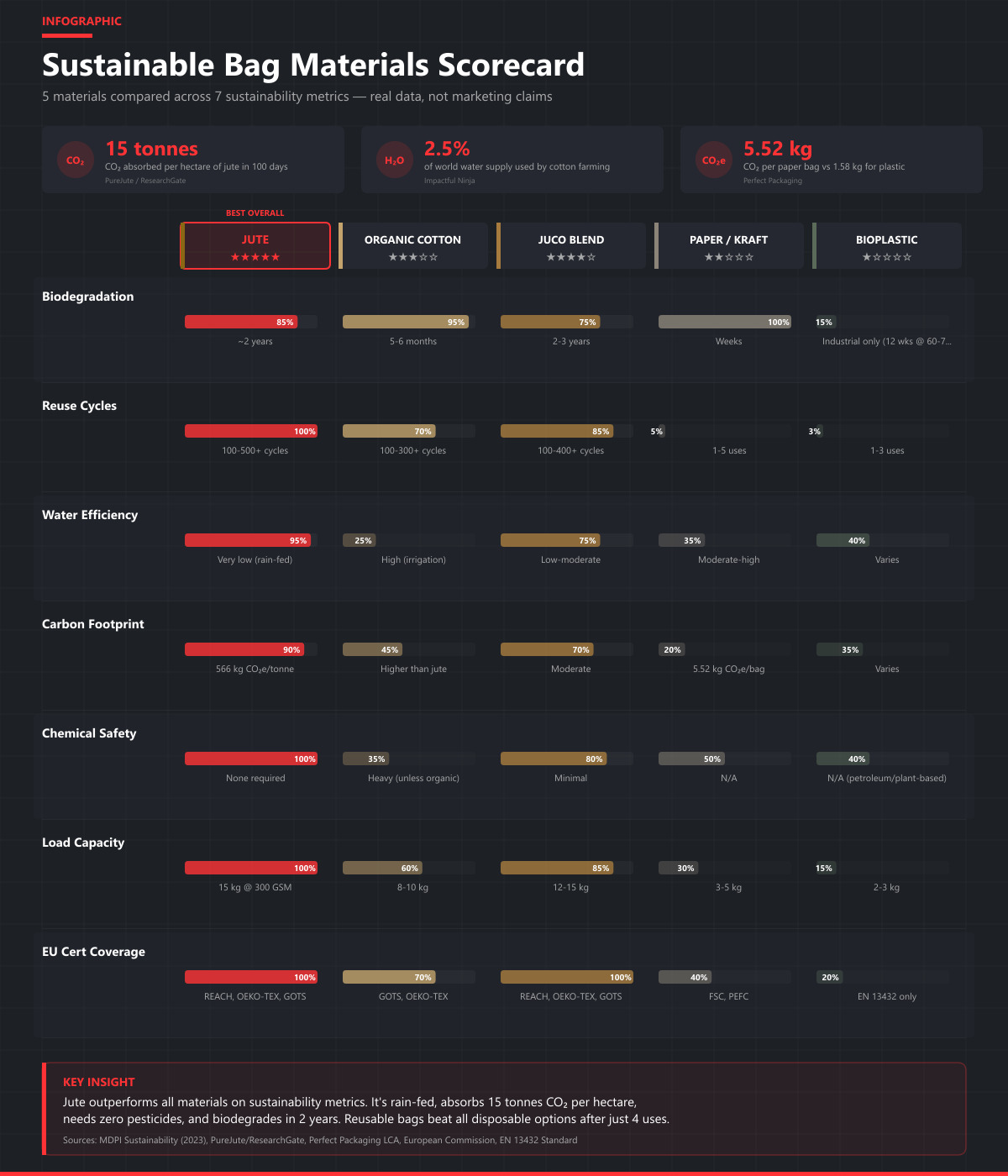
A study in MDPI Sustainability found that jute fibres beat cotton on green impact across all areas tested.
EU Certifications That Actually Matter for Sustainable Packaging Bags
The certs your European buyers care about aren't the ones most supplier sites mention. FSC and PEFC matter for paper packaging. But if you're sourcing textile-based sustainable packaging bags - jute, cotton, or blended - three certs split the real suppliers from the rest.
REACH Compliance: What It Tests and Why European Customs Care
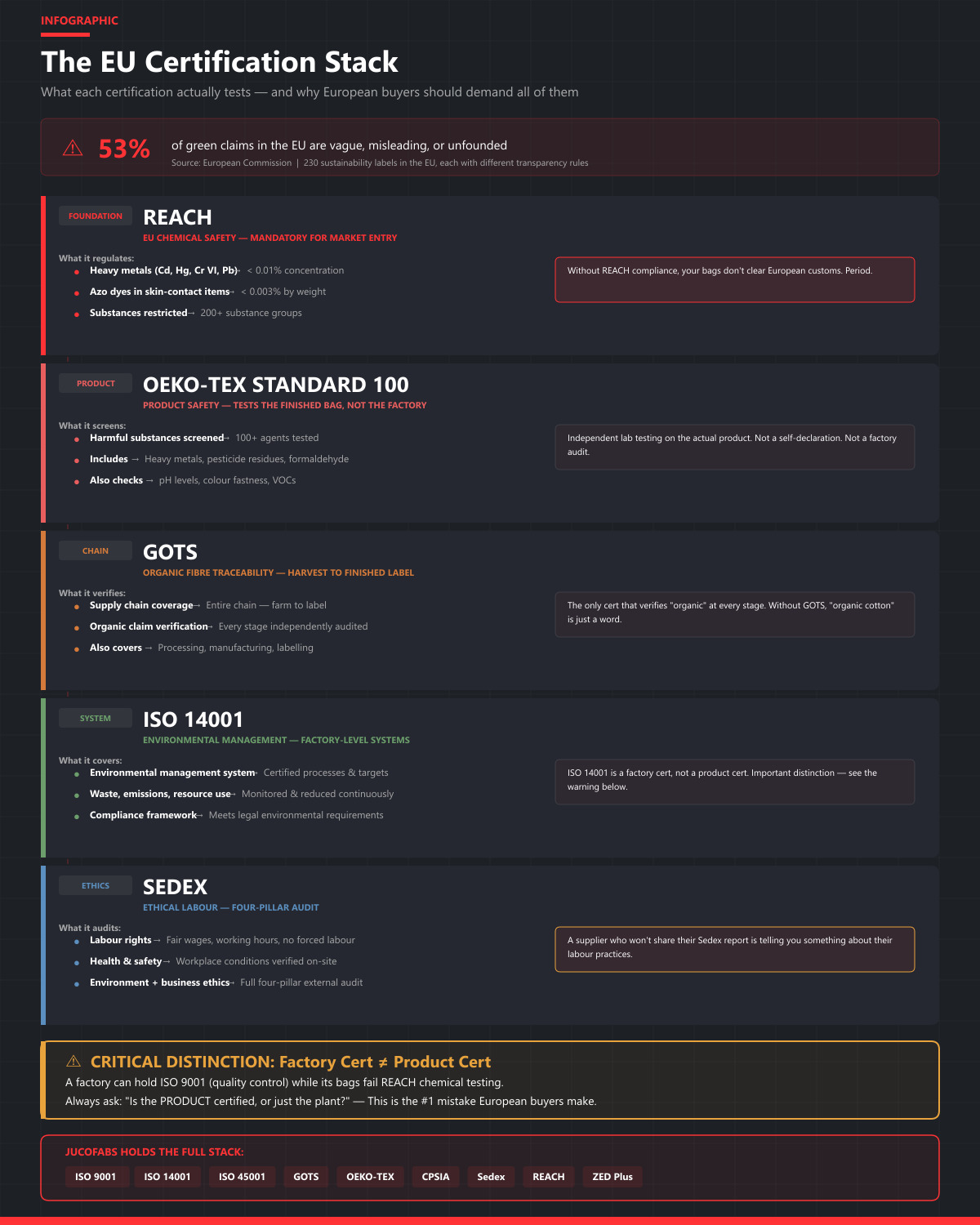
REACH is the EU rule that controls chemicals in products entering Europe. It's not optional. Per ECHA's REACH Annex XVII list, the sum of heavy metals - cadmium, mercury, chromium VI, and lead - must stay below 0.01% in packaging.
For textile bags, REACH caps azo dyes at 0.003% by weight in skin-contact items. Why? Some azo dyes release cancer-causing amines. That's not theory. It's why bags get stopped at European customs.
We use only azo-free dyes. Every batch. It costs more than standard dyes. But when your bags go into European retail stores - touching food, pressed against skin - this isn't where you cut costs.
We've seen rivals' shipments held at port because they couldn't show a REACH test report. The supplier saved money on dyes. The buyer lost months.
OEKO-TEX STANDARD 100: Beyond the Label
OEKO-TEX STANDARD 100 tests the finished bag - not the factory, not the raw fibre, but the actual product your buyer will hold. It screens for over 100 harmful agents: heavy metals, pesticide traces, formaldehyde, pH levels, colour fastness.
If a bag carries this cert, it's been tested by outside labs and cleared as safe for human contact.
We hold OEKO-TEX STANDARD 100 and test every run against it. The gap between this and a supplier's "chemical-free" claim is the gap between an audit trail and a promise.
GOTS, ISO 14001, and Sedex: The Full Stack
GOTS (Global Organic Textile Standard) covers the whole supply chain for organic fibres - from harvest to label. If your bags use organic cotton, GOTS is the only cert that checks the "organic" claim at every stage.
ISO 14001 covers your supplier's green management system. Sedex audits ethical labour across four pillars: labour rights, health and safety, the environment, and business ethics.
With REACH and OEKO-TEX, these form what we call the "full stack." It's the cert mix that tells a European buyer: this supplier is serious.
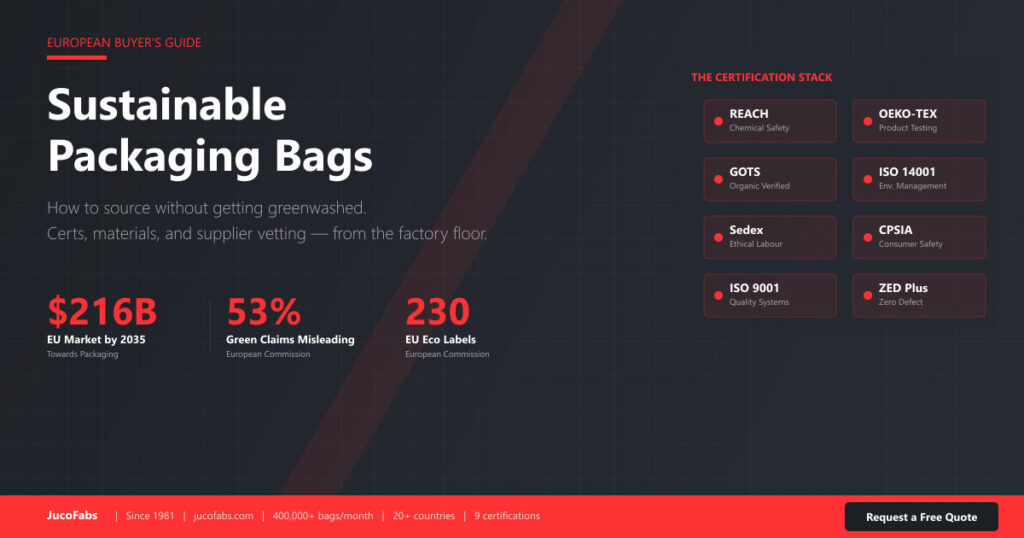
JucoFabs (jucofabs.com) holds all of them: ISO 9001, ISO 14001, ISO 45001, GOTS, OEKO-TEX STANDARD 100, CPSIA, Sedex, REACH, and ZED Plus. Not because we collect logos - because European buyers deserve proof, not promises.
Want to see our full cert proof? Request it with a free quote from JucoFabs.
The EU Packaging and Packaging Waste Regulation (PPWR):
What Buyers Need to Know
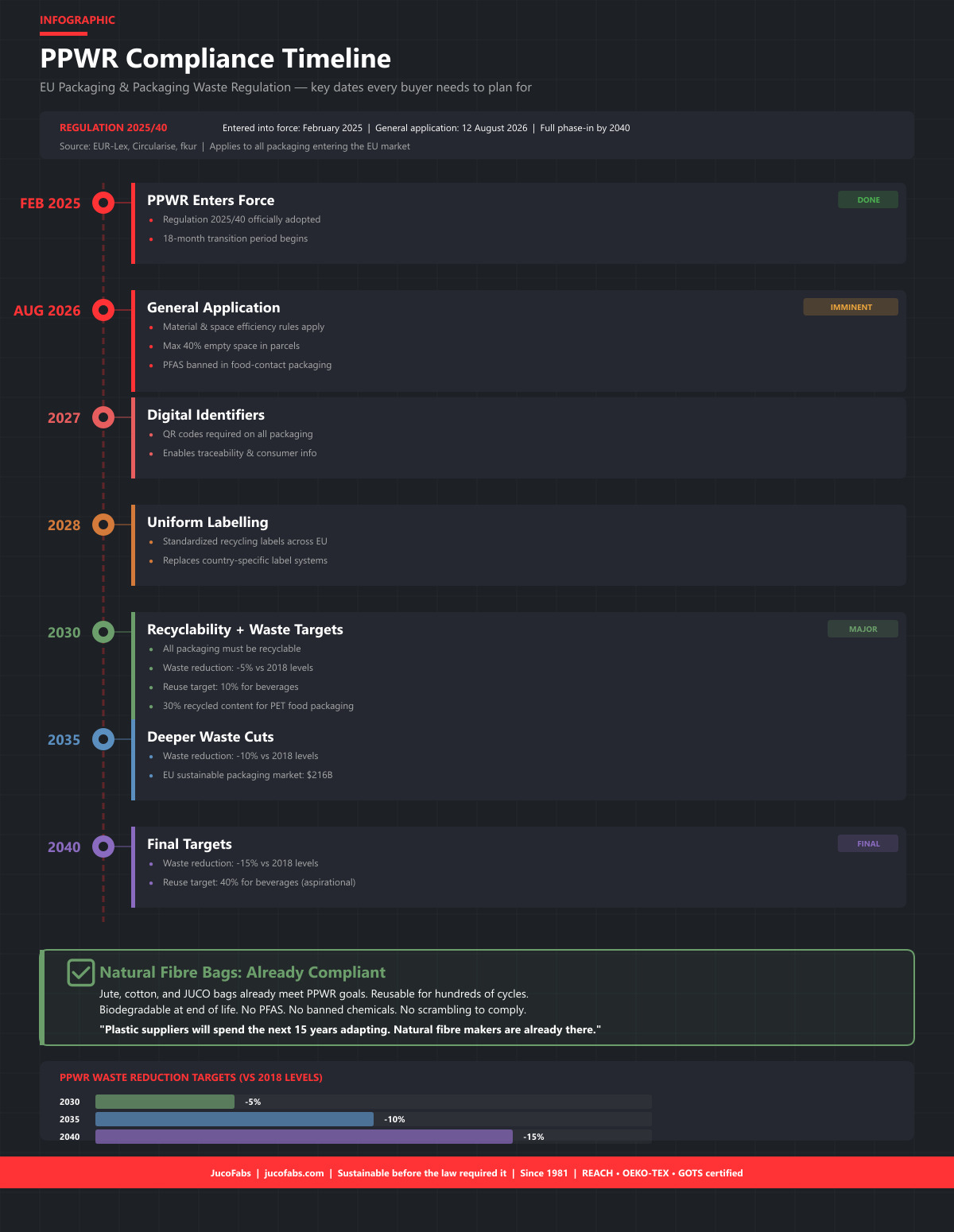
According to the EUR-Lex summary, the PPWR took effect in February 2025. It applies from 12 August 2026. If you're sourcing sustainable packaging bags for Europe, this law changes the game.
Here's what matters for bag buyers. The PPWR sets waste cuts: 5% by 2030, 10% by 2035, and 15% by 2040 versus 2018 levels. It bans PFAS in food packaging outright. It also requires QR codes on packaging from 2027 and standard recycling labels from 2028.
Why does this matter for bag sourcing? Good news for natural fibre. Jute, cotton, and JUCO bags are already in line with the PPWR's goals. They're reusable for hundreds of cycles. They break down at end of life. And they hold none of the banned chemicals the law targets. A jute bag doesn't need a PFAS ban because it never held PFAS.
The law also sets reuse targets. Per reporting from Circularise, 10% of drinks must ship in reusable packaging by 2030 - with a stretch goal of 40% by 2040. For retailers watching these numbers, buying durable bags now isn't just green. It's smart planning.
Plastic bag suppliers will spend the next ten years adapting to the PPWR. Natural fibre makers are already there. That's not spin - it's the built-in edge of working with materials that were green before the law existed.
How to Spot Greenwashing in Sustainable Packaging
(Red Flags Every Buyer Should Know)
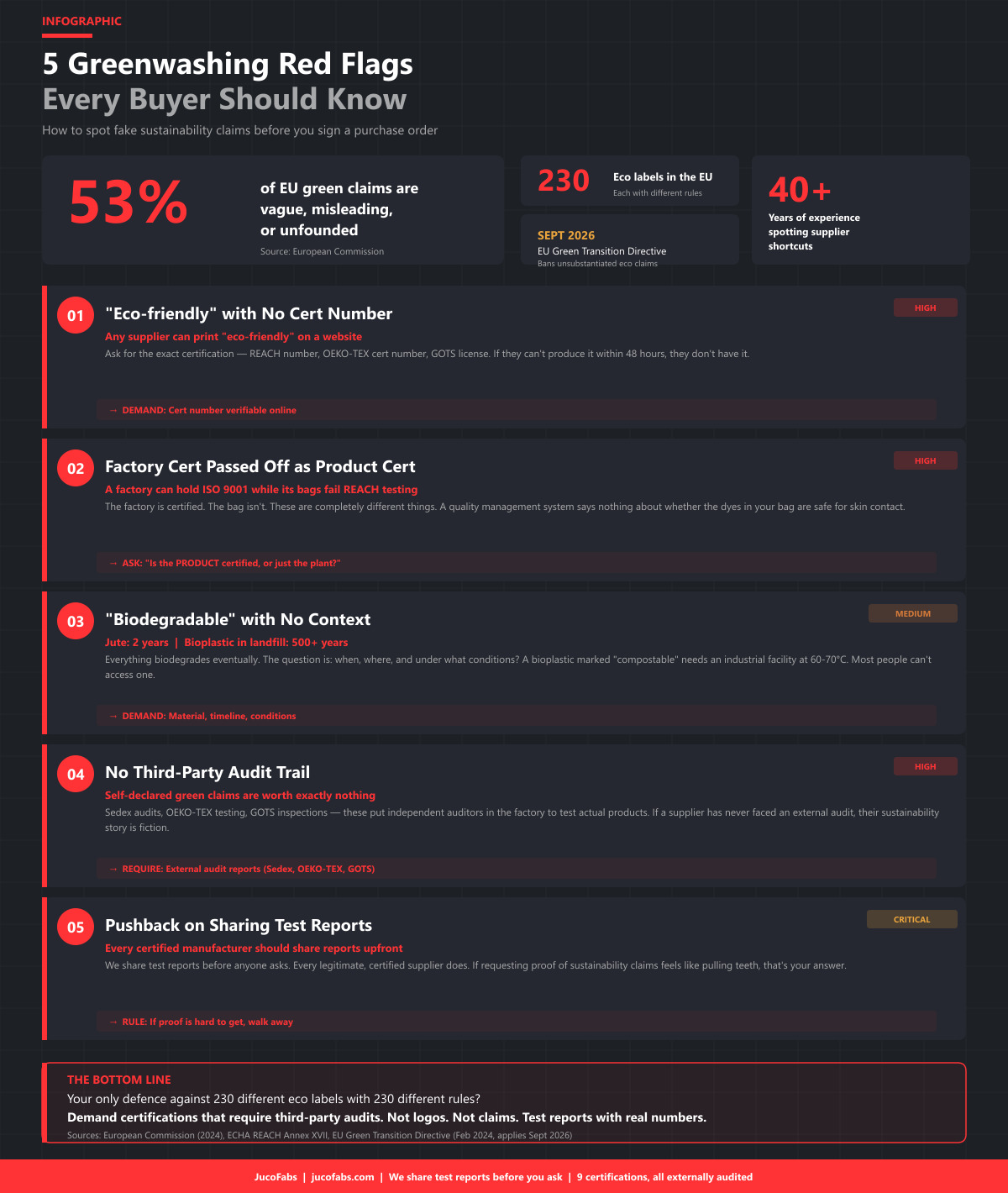
According to the European Commission, 53% of green claims in the EU are vague, misleading, or plain wrong. Starting September 2026, the EU's Green Transition Directive will ban empty "eco-friendly" and "climate neutral" claims. The patience for greenwashing is running out.
After four decades of going up against suppliers who cut every corner, we've learned to spot the patterns. Here are the red flags that should stop any buying talk:
"Eco-friendly" with no cert number. Any supplier can print "eco-friendly" on a site. Ask for the exact cert - REACH number, OEKO-TEX cert number, GOTS license. If they can't show it within 48 hours, they don't have it.
Factory cert passed off as product cert. A factory can hold ISO 9001 (quality control) while its bags fail REACH chemical testing. The factory is certified. The bag isn't. Always ask: "Is the product certified, or just the plant?"
"Biodegradable" with no context. It means it will break down. But when? 2 years (jute) or 500 years (some bioplastics in a landfill)? Ask for the material, the timeline, and the conditions.
No outside audit trail. Self-declared green claims mean nothing. Sedex audits, OEKO-TEX testing, GOTS checks - these put outside auditors in the factory to test products. If a supplier has never faced an outside audit, their green story is fiction.
Pushback on sharing test reports. We share test reports up front. Every certified maker should. If asking for proof feels like pulling teeth, that's your answer.
The European Commission counts 230 green labels in the EU, each with its own rules. Your only defence? Demand certs that require outside checks. Not logos. Not claims. Test reports with real numbers.
The Supplier Vetting Checklist: 7 Steps Before You Sign a Purchase Order
Vetting a sustainable packaging bag supplier doesn't take guesswork - it takes a system. Here's the one we've built from four decades of making and exporting bags to Europe. Use it on any supplier. Including us.
Step 1: Ask for specific certs. Request REACH proof, OEKO-TEX STANDARD 100 cert, and GOTS cert (if they claim organic). Not "we're working on it." Not "we meet global standards." The actual cert. With a number you can verify online.
Step 2: Ask for outside test reports. REACH testing covers heavy metals, azo dyes, formaldehyde, pH. OEKO-TEX tests 100+ substances. Ask for the newest report - not one from 5 years ago. Good suppliers test often and keep current proof ready.
Step 3: Check ethical labour. Request the Sedex audit report. It covers labour rights, health and safety, green management, and business ethics. A supplier who won't share this is telling you something.
Step 4: Order samples and check specs. For jute bags, check the GSM (200-300 for shopping bags, 300-400+ for heavy-duty). Check dye fastness per ISO 105 standards. Feel the fabric. A sample tells you more than any catalogue.
Step 5: Confirm MOQ and lead times. Standard MOQs for custom jute bags range from 500 to 5,000 units. Lead times from India to Europe run 4-8 weeks for making plus 3-4 weeks for shipping. If a supplier quotes far outside these ranges, dig into why.
Step 6: Check capacity and batch quality. Ask about factory count, monthly output, and how they keep quality steady across large runs. Batch gaps are the top complaint European buyers have about overseas suppliers. It's almost always a capacity or process control issue.
Step 7: Ask for European client names. A supplier who's shipped to European retailers and wholesalers knows the rules, the shipping, and the comms style buyers expect. If they can't name a single European client, you're their test case.
Ready to put this checklist to work? Start with a manufacturer who'll pass every step - request a quote from JucoFabs.
What to Expect from a Certified Sustainable Bag Manufacturer
A certified maker looks very different from a supplier with a nice website. Here's what the real ones offer - and what you should demand.
Open books. You should be able to ask about factory capacity, how bags are made, and quality control - and get straight answers. We produce 400,000+ bags monthly across three factories totalling 20,500+ square feet. That's not a marketing number. It's a fact you can verify with a factory visit.
Custom builds, no shortcuts. Printing, sizing, material blends, handle styles, closures, private labels - a real partner adapts to your specs. The gap between a supplier and a partner? One asks "what do you need?" The other says "here's what we have."
Low MOQs. We start at 500 units. That matters for European SMEs, startups, and niche retailers who need sustainable bags but can't commit to 10,000-piece minimums. Not every buyer is a chain retailer - a good maker serves the range.
A cert stack that invites hard questions. JucoFabs holds ISO 9001, ISO 14001, ISO 45001, GOTS, OEKO-TEX STANDARD 100, CPSIA, Sedex, REACH, and ZED Plus. We didn't collect these because they look good on a site. Each one means an outside audit and a testing process.
Most suppliers skip these certs because they're costly and tough. We welcome them because we've built our whole operation around passing them.
Comms that match European norms. Export track record matters. We've shipped to Germany, France, the UK, Spain, Italy, and across Europe for years. We know EU import paperwork, label rules, and the comms pace European teams expect. Since 1981.
Frequently Asked Questions About Sustainable Packaging Bags
What is the most sustainable material for packaging bags?
Jute wins. It grows on rain alone, soaks up about 15 tonnes of CO2 per hectare in 100 days, needs no pesticides, and breaks down in roughly 2 years. Cotton, by contrast, drinks 2.5% of the world's water supply.
Per studies in MDPI Sustainability, jute beats cotton on green impact across all areas tested. For a closer look at natural fibre bags, see our cotton vs jute vs canvas comparison.
Are paper bags more sustainable than plastic bags?
Not as clear-cut as you'd think. Per data from Perfect Packaging, a paper bag emits roughly 5.52 kg CO2e versus plastic's 1.58 kg CO2e. Paper also creates more air and water pollution in the making.
But paper breaks down, recycles easily, and doesn't sit in oceans for centuries. The real answer? Neither is great. Reusable bags - jute, cotton, JUCO - beat both throwaway options after just 4 uses across all green metrics. The best choice isn't paper or plastic. It's reusable.
What's the difference between compostable and biodegradable packaging bags?
Two very different things. Under the EN 13432 European standard, "compostable" means it breaks down in an industrial plant (60-70°C) within 12 weeks. "Biodegradable" just means it will break down at some point. No set timeline. No set conditions.
A jute bag breaks down in about 2 years in soil. A bioplastic bag marked "compostable" needs an industrial plant most people can't access. This matters - especially if your marketing makes claims to European buyers who expect the bag to rot in a garden bin.
How much do sustainable packaging bags cost compared to plastic?
Per unit, a custom jute or cotton bag costs more than a plastic bag - 5-20x more depending on specs, printing, and volume. But that's the wrong comparison. A jute bag gets reused 100-500+ times. A plastic bag gets used once.
On a cost-per-use basis, reusable bags are cheaper. And with the PPWR pushing waste cuts and extended producer costs for single-use packaging, the math shifts further toward reusable every year.
What MOQ should I expect from a sustainable bag manufacturer?
Standard MOQs for custom sustainable packaging bags range from 500 to 5,000 units, based on how much custom work is involved. Some makers require 3,000-5,000 minimum. JucoFabs starts at 500 units - putting certified, custom bags within reach for startups, niche retailers, and SMEs who can't meet high minimums. For stock designs with no custom work, some suppliers go even lower.
The European market for sustainable packaging bags isn't slowing down. Per Towards Packaging, it's heading toward USD 216 billion by 2035. Rules are getting tighter. Buyers want proof, not promises. The suppliers who make it through this shift are the ones who built around real green practices - not the ones rushing to add a leaf icon to their site.
You know what to look for now. The certs that matter. The red flags that don't lie. The questions that split real makers from smooth talkers. The next step is simple: find a supplier who doesn't flinch when you ask for the test reports.
We've been making sustainable bags since before the word "sustainable" showed up in buying briefs. Since 1981. Every bag tested. Every cert earned. Every factory audited.
Request a quote from JucoFabs - certified, custom sustainable packaging bags, made for Europe and shipped worldwide.