



Jute wine bags have become the go-to choice for U.S. corporate gifting because they solve three problems at once: they're sustainable, they look premium, and they can be fully branded with your company's identity — all from a single supplier. For procurement managers sourcing wine gift packaging at scale, jute offers what paper, plastic, and generic fabric bags can't: a reusable, biodegradable carrier that reinforces your brand values every time the recipient reaches for it again.
But here's what most product pages won't tell you. The shift toward jute wine bags isn't just an eco trend. It's a procurement-level response to something much bigger — the growing evidence that sustainable packaging directly influences customer loyalty and brand perception. We see it on the manufacturing floor every quarter: U.S. corporate orders for custom jute wine bags have been climbing steadily, and the requests are getting more specific, more branded, and more strategically intentional. Five years ago, most of our U.S. orders were for plain, unbranded bags. That's not the case anymore.
This guide covers what a procurement manager actually needs to know — why jute is winning the material comparison, how customization works at scale, and the certifications and timelines that matter for corporate compliance. Written from the manufacturer's side of the table.
Why U.S. Corporate Buyers Are Choosing Jute Wine Bags in 2026
The corporate gifting market is projected to grow at nearly 8% annually, on track to exceed $1 trillion by the end of the decade. That's a lot of money flowing into gifts — and increasingly, the packaging of those gifts arrives in matters as much as the gift itself.
McKinsey research confirms the shift: products with ESG-related claims grew 28% over five years, outpacing non-ESG products at 20%. And more than 60% of U.S. consumers now say sustainable packaging influences their purchase decisions — up from 35% just five years ago.
What does this look like on the ground? At JucoFabs, we've watched the pattern change in real time. Corporate buyers aren't asking for "the cheapest wine bag you've got." They're asking for Pantone-matched, logo-embroidered, OEKO-TEX certified jute carriers — because their procurement teams have figured out that the bag isn't just wrapping. It's a brand statement.
The 2026 trend data backs this up. Natural textures like jute, cotton, and canvas are the defining material choice for corporate gifts this year, according to GreenOBag's industry analysis. Companies are moving away from plastic-heavy packaging toward minimal, mono-material designs — and jute fits that brief perfectly.
This isn't a niche trend anymore. Sustainable corporate gifting is now a business imperative. The brands that get this right build trust. The ones that don't get outcompeted by brands that do.
What Makes Jute the Ideal Material for Corporate Wine Gift Bags?
Jute is one of the few natural fibers that's genuinely carbon negative. Research published in peer-reviewed journals confirms that jute plants absorb more CO2 during growth than they produce across their entire lifecycle. The fiber is 100% biodegradable, decomposing naturally in just 2-3 months, and it releases no toxic gases when broken down.
But procurement managers don't buy materials for their carbon credentials alone. They buy them because they perform.
Jute fibers have high tensile strength — originally developed by nature for the heavy loads of agricultural sacking. That same durability means a branded jute wine bag gets used again and again. Research from the Promotional Products Association International shows that 89% of recipients recall the brand on promotional bags even two years after receiving them. Every reuse is another brand impression. Paper bags get tossed. Plastic bags get shoved in a drawer. A well-made jute wine bag sits on a kitchen counter or gets carried to the next dinner party.
The texture matters too. Jute has a natural, earthy aesthetic that reads as premium without trying too hard. It photographs well for social media. It pairs with wine in a way that feels intentional rather than generic. For corporate gifts, that visual quality signals thoughtfulness — the kind of detail recipients notice and remember.
Jute vs. Cotton vs. Canvas vs. Paper: Which Wine Bag Material Wins for Corporate Gifting?
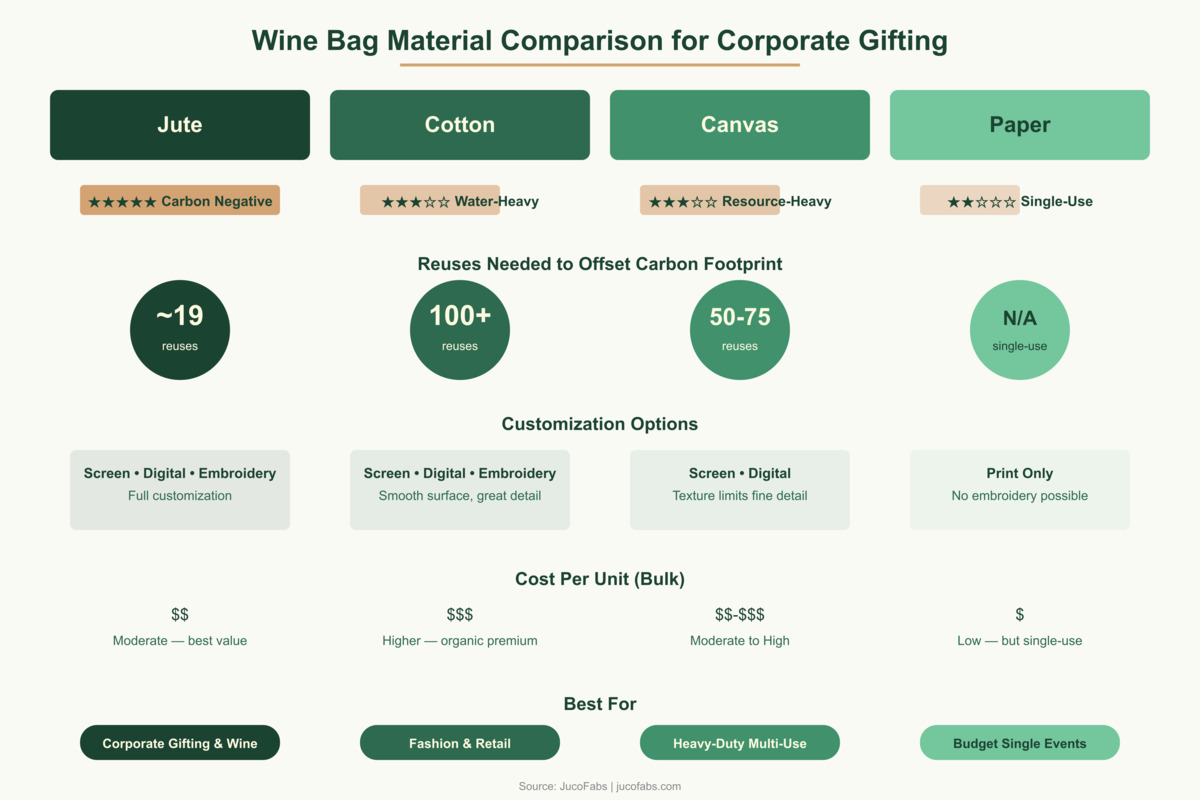
Not every eco-friendly material is created equal, and for wine gift bags specifically, the differences matter. Here's how jute stacks up against the alternatives that procurement teams typically consider:
| Feature | Jute | Cotton | Canvas | Paper |
|---|---|---|---|---|
| Durability | High — handles heavy bottles with ease | High — soft but strong | Very high — thickest option | Low — tears with weight/moisture |
| Eco Score | Excellent — carbon negative, biodegrades in 2-3 months | Good — but water-intensive to grow | Good — durable but resource-heavy production | Mixed — biodegradable but single-use |
| Reuses to Offset Footprint | ~19 uses | ~100+ uses | ~50-75 uses | Not reusable |
| Customization | Excellent — screen print, digital, embroidery all work | Excellent — smooth surface for printing | Good — texture can affect fine detail | Limited — print only, no embroidery |
| Cost Per Unit (bulk) | Moderate — affordable at scale | Higher — organic cotton is premium | Moderate-High | Low — but single-use adds up |
| Brand Perception | Premium, earthy, sustainable | Classic, clean, versatile | Rugged, substantial | Basic, disposable |
| Best For | Corporate gifting, wine, eco-branding | Fashion-forward gifts, retail | Heavy-duty, multi-purpose | Budget events, single-use needs |
The standout number: jute needs only about 19 reuses to offset its production footprint, compared to over 100 for cotton. For a corporate gift that gets reused at dinner parties, wine tastings, and farmers' markets, jute reaches carbon payback fast.
Cotton's a solid material — we manufacture cotton bags too, so we're not knocking it — but it's notoriously water-intensive to produce. Canvas is durable but often overkill (and pricier) for a wine bag. Paper works for one-time events but doesn't deliver the brand longevity or reuse value that makes corporate gifting worthwhile.
For a detailed breakdown of material properties, our comparison of cotton, jute, and canvas bags goes deeper into the manufacturing differences.
Customization Options: How to Brand Jute Wine Bags for Your Corporate Identity
This is where most procurement managers hit a wall. They find a supplier who sells plain jute bags — but the moment they need a specific Pantone color, an embroidered logo, or a custom closure, they're told to find another vendor.
We hear this frustration constantly. And honestly? It's one of the reasons we built our production line the way we did. One-stop customization — from fabric selection through printing to final packaging — is the difference between a smooth procurement process and a multi-vendor headache. Here's what full customization actually looks like from the manufacturing side.
Printing Methods Compared: Screen Print vs. Digital vs. Embroidery
Screen printing is the workhorse for bulk corporate orders. It's cost-effective at high volumes, produces crisp single-color and multi-color logos, and handles the textured surface of jute well. Best for: clean logos, bold branding, large runs.
Digital printing allows full-color, photographic-quality designs directly on the fabric — including cotton gusset panels for maximum detail. Best for: intricate designs, multi-color artwork, smaller custom runs.
Embroidery adds a tactile, premium dimension that printed logos can't match. The thread work catches light and creates depth. Best for: luxury corporate gifts, executive-level presentations, high-end brand positioning.
For print clarity on jute, aim for minimum text height of 0.5 inches and line thickness of 0.03 inches — jute's natural texture is part of the charm, but fine detail needs proper sizing to stay sharp.
Size Guide: Choosing the Right Configuration for Your Gifting Program
The configuration depends on your gifting strategy:
- Single-bottle bags — the standard for individual corporate gifts. Clean, elegant, personal.
- Two-bottle bags with internal dividers — for premium client gifts or holiday pairings.
- Four and six-bottle bags — for events, team gifts, or VIP packages.
At JucoFabs, we manufacture bags across all configurations with customizable GSM weights (260-340) and multiple fabric options including pure jute and JUCO (jute-cotton blend) for added softness.
The Procurement Playbook: MOQs, Lead Times, and Ordering Timelines
Here's the part that most supplier websites bury or skip entirely.
Minimum order quantities (MOQs) for custom-printed jute wine bags typically start at 1,000 pieces. Some suppliers offer lower MOQs for blank or pre-designed bags, but full customization — your logo, your colors, your specifications — generally requires that 1,000-unit threshold for efficient production.
Lead times run 4-6 weeks from final artwork approval to delivery for fully custom orders from a manufacturer. That includes sampling, production, quality control, and shipping. U.S.-based resellers may offer faster turnaround (5-7 business days) for basic customization, but the trade-off is typically limited options, higher per-unit cost, and less control over material sourcing.
Cost structure scales with volume. Expect meaningful unit price reductions at 2,500, 5,000, and 10,000+ piece thresholds. Screen printing is the most cost-effective method at scale; embroidery adds a premium that's justified for executive-level gifts.
Planning Your Corporate Gifting Calendar: When to Order
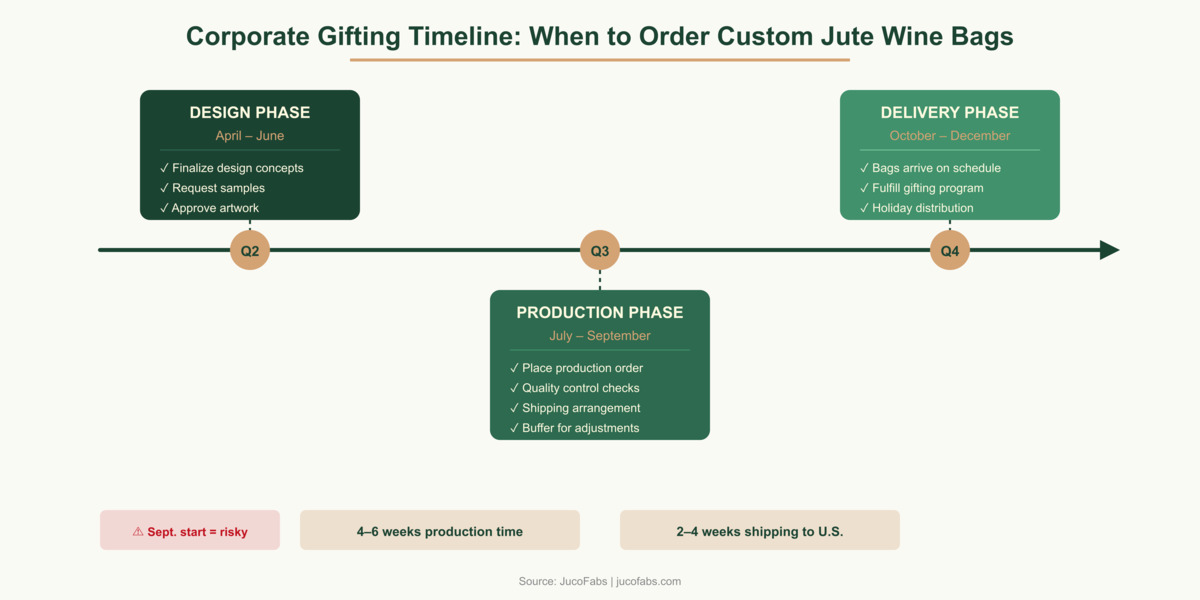
This is where we see procurement teams get caught off-guard. If your company runs a Q4 holiday gifting program — and most do — here's the timeline that actually works:
- Q2 (April-June): Finalize design concepts, request samples, approve artwork
- Q3 (July-September): Place production order, build in time for quality checks and shipping
- Q4 (October-December): Bags arrive, fulfill gifting program on schedule
Starting in September for December delivery? That's cutting it dangerously close — and we've seen it go sideways more than once. Starting in Q2 gives you room for revisions, production adjustments, and the unexpected delays that are part of any international supply chain. Trust us on this one.
Sustainability Certifications That Matter for Corporate Procurement
When you're sourcing packaging for a corporate gifting program, "eco-friendly" on a product page isn't enough. Procurement teams need verifiable certifications — both for internal compliance and for the ESG reporting that's increasingly required.
Here's a quick reference for the certifications that matter most:
| Certification | What It Verifies | Why It Matters for Procurement |
|---|---|---|
| OEKO-TEX Standard 100 | Every component (fabric, thread, ink, closures) tested against hundreds of harmful chemicals | Product safety assurance — meets consumer protection standards |
| SEDEX (SMETA) | Ethical manufacturing across four pillars: labor, health & safety, environment, business ethics | Social compliance for vendor evaluation and CSR reporting |
| REACH | Compliance with EU chemical regulation (1,907+ substances) | Required for products entering or sourced from EU markets |
| CPSIA | U.S. Consumer Product Safety Improvement Act compliance | Required for products distributed in the U.S. |
| ISO 9001 / 14001 / 45001 | Quality management / Environmental management / Occupational health & safety | Process standardization and continuous improvement verification |
| GOTS | Global Organic Textile Standard — organic fiber content and processing | For buyers requiring organic certification claims |
With seven U.S. states having enacted Extended Producer Responsibility legislation for packaging by 2025 — and more expected in 2026 — certified suppliers aren't just a preference. They're becoming a requirement.
A practical tip: ask potential suppliers for certification numbers, not just logos. Legitimate certifications are verifiable on the issuing body's website. At JucoFabs, we maintain OEKO-TEX, SEDEX, ISO 9001/14001/45001, CPSIA, and REACH compliance — and we can provide documentation on request.
How Branded Jute Wine Bags Boost Corporate Brand Perception
Let's talk about what a branded jute wine bag actually does for your company after it leaves the gifting event.
NielsenIQ research shows 78% of global consumers prefer eco-friendly packaging, and 90% are more likely to purchase from brands that use it. When your corporate gift arrives in a branded jute bag, you're not just packaging a bottle — you're sending a signal about your company's values.
A 2025 consumer report found that 54% of consumers actively chose products with sustainable packaging in the preceding six months. Your recipients are part of that trend. The bag becomes part of the message.
And the exposure doesn't stop at the gifting moment. Because jute bags are durable and genuinely reusable — for wine runs, farmers' markets, kitchen storage — your brand travels. PPAI research shows 85% of recipients remember the advertiser who gave them a promotional item, and 88% go on to research the company. That's ongoing brand visibility from a single gifting investment.
The best part? Unlike a digital ad that disappears from a feed, a physical bag sitting on someone's kitchen counter creates a daily micro-impression. That's the kind of brand recall you can't buy — but you can gift.
How to Source Jute Wine Bags for Your Corporate Gifting Program
Here's a straightforward sourcing workflow, from first search to final delivery:
- Define your requirements — Quantity, bottle configuration, material preferences, customization needs, certification requirements, budget range, delivery timeline.
- Request samples — Never commit to a bulk order without physical samples. Evaluate stitching quality, fabric weight, print clarity, and handle durability.
- Evaluate the supplier — Use the checklist below to assess whether a supplier can actually deliver on their promises.
- Negotiate pricing — Get tiered quotes at multiple volumes. Compare all-in costs (product + customization + shipping + duties, if importing directly).
- Approve artwork and place the order — Get a digital proof AND a pre-production sample before final approval.
- Quality control — Request photos or a third-party inspection before shipping. This is standard practice for direct manufacturing orders.
- Receive and distribute — Build in a buffer for receiving and internal distribution logistics.
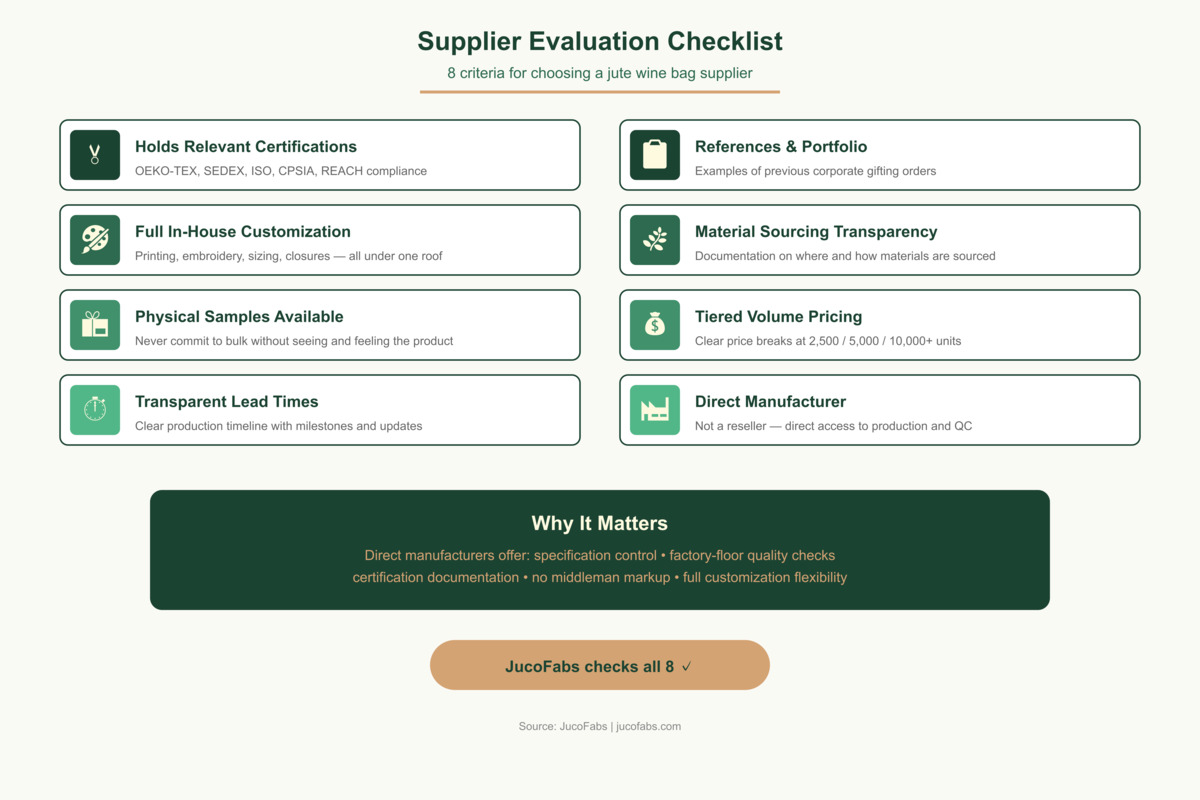
Supplier Evaluation Checklist:
- ☐ Holds relevant certifications (OEKO-TEX, SEDEX, ISO, CPSIA, REACH)
- ☐ Offers full customization in-house (printing, embroidery, sizing, closures)
- ☐ Provides physical samples before bulk commitment
- ☐ Has transparent lead time and production timeline
- ☐ Can provide references or examples of previous corporate orders
- ☐ Shares material sourcing documentation on request
- ☐ Offers tiered pricing with clear volume break points
- ☐ Is a direct manufacturer (not a reseller marking up someone else's product)
Why does the manufacturer-vs-reseller distinction matter? Look, we're obviously biased here — but the difference is real. Direct manufacturers give you control over specifications, access to quality control at the source, certification documentation from the factory floor, and pricing without middleman markup. Resellers offer convenience and faster U.S.-based shipping for standard items — but limited customization and less visibility into the supply chain. For a 500-piece blank bag order, a reseller is fine. For a 5,000-piece branded campaign with specific Pantone colors and embroidery? You want to talk to the people making the bags.
For a broader look at the U.S. wholesale landscape, our sustainable packaging guide for U.S. buyers covers the full picture.
Frequently Asked Questions About Jute Wine Bags for Corporate Gifting
Are jute wine bags truly eco-friendly?
Yes — and verifiably so. Jute is 100% biodegradable, decomposing in 2-3 months without releasing toxic substances. It's carbon negative during growth, requiring minimal water, no pesticides, and no fertilizers. Look for OEKO-TEX certification to verify that the finished product (including inks and closures) is free from harmful chemicals. For deeper context, read about the environmental benefits of jute bags.
What's the typical cost per unit for custom jute wine bags?
Pricing varies by configuration, customization complexity, and order volume. At scale (1,000+ pieces), custom-printed single-bottle jute wine bags are affordable and competitive with premium paper alternatives — with the added value of reusability and brand longevity. Request quotes at multiple volume tiers to find the price point that fits your program.
What's the difference between jute, burlap, and hessian?
They're all the same fiber. "Jute" is the plant and technical term. "Burlap" is the common U.S. name for jute fabric. "Hessian" is the British and Australian term. When you see any of these on a product listing, you're looking at the same natural material.
How far in advance should I order custom wine bags for holiday gifting?
For fully custom orders from a manufacturer, plan for 4-6 weeks of production plus shipping time. For Q4 holiday delivery, start the design and sampling process in Q2 (April-June) and place your production order by Q3 (July-September). Rush orders are sometimes possible but come with premium pricing and less room for error.
Can jute wine bags be used for non-wine gifts?
Absolutely. The same bags work for olive oil bottles, artisan spirits, specialty sauces, candles, or any cylindrical gift item. Corporate gifting programs often repurpose the same bag design across multiple product types throughout the year.
What compliance certifications should procurement teams look for?
At minimum: OEKO-TEX Standard 100 (product safety), SEDEX/SMETA (ethical manufacturing), and CPSIA compliance (U.S. consumer safety). For programs with ESG reporting requirements, ISO 14001 (environmental management) and REACH compliance add another layer of verifiable sustainability documentation.
Your Next Corporate Gift Should Say Something
The shift toward jute wine bags in corporate gifting isn't about following a trend. It's about making a deliberate choice — one that aligns your brand values with the packaging your clients actually hold in their hands.
Procurement managers who get this right don't just check the "sustainable packaging" box. They create gift experiences that get remembered, get reused, and get talked about. The bag becomes part of the brand story.
And the data is clear: eco-friendly packaging drives loyalty, reusable branded items generate years of recall, and the market is moving in one direction.
The first step is simple. Define your specs, request a sample, and see the quality for yourself.