

Certifications, MOQs, logistics, and supplier vetting — from the factory floor since 1981.
European businesses can source wholesale jute bags by working directly with certified manufacturers in India who hold EU-required certifications - REACH, OEKO-TEX STANDARD 100, GOTS, and Sedex - with minimum orders as low as 500 units and established shipping routes to Western Europe. The key is verifying certifications before you talk price, requesting production-grade samples, and confirming the supplier has a documented EU export track record.
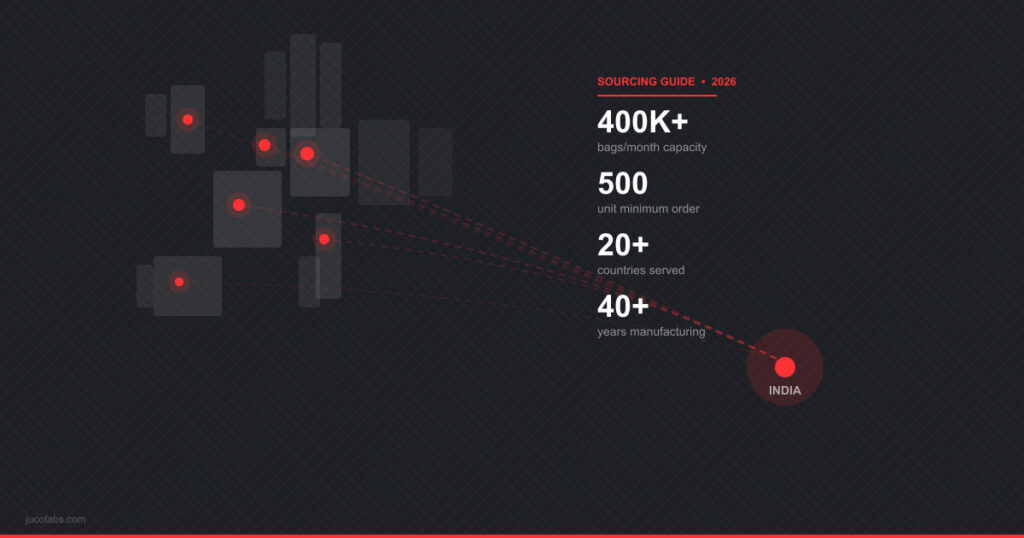
Here's the reality most European buyers hit: you search "wholesale jute bags" and get 1,800+ Alibaba listings, a handful of European resellers marking up 30%, and zero clarity on which supplier can actually clear EU customs without a problem. We know because we've been on the manufacturing side of that equation since 1981 - exporting jute bags to the UK, Germany, France, Spain, Italy, and the Netherlands. We've watched buyers make the same sourcing mistakes for decades. Some of those mistakes cost thousands. A few cost entire business relationships.
This guide gives you the exact framework we'd want every European buyer to have before placing a single order. Not theory. Not a supplier directory. A manufacturer's honest breakdown of how this market actually works.
Why European Demand for Wholesale Jute Bags Is Surging in 2026
The numbers don't lie. According to The Business Research Company's 2026 report, the global jute bags market is projected to grow from $2.68 billion in 2025 to $2.95 billion in 2026 - a CAGR of 9.8%. Europe is leading that charge.
Future Market Insights reports that Europe represents the fastest-growing jute bag market with a CAGR of 6.2%, driven by strict environmental regulations and strong consumer demand for sustainable products. That demand isn't discretionary - it's policy-driven.
The EU's Single-Use Plastics Directive, fully enforced since 2021 and tightened through supplementary regulations in 2025, has pushed retailers, grocery chains, and corporate buyers toward reusable alternatives. According to Business Research Insights, jute bags now hold approximately 38.4% of the reusable bag market - the most direct functional replacement for single-use plastic. Over 60 countries worldwide have implemented some form of plastic bag restriction as of early 2026.
And there's a deadline approaching that a lot of buyers aren't paying attention to. The EU's new Packaging and Packaging Waste Regulation (PPWR) takes effect on August 12, 2026. It applies to all packaging placed on the EU market - regardless of material or origin - and introduces new documentation, recyclability, and substance restriction requirements. If you're buying wholesale bags for European retail, this regulation affects you. Four months isn't a lot of runway.
India's jute exports to the EU have increased by over 25% in the past two years, with Germany, France, the Netherlands, and Italy among the top importers. The question isn't whether to switch to jute - it's how to source it without getting burned.
The EU's Single-Use Plastics Directive has pushed retailers, grocery chains, and corporate buyers toward reusable alternatives. Jute bags now hold approximately 38.4% of the reusable bag market.
What Types of Jute Bags Can You Order Wholesale?
The jute bag category is broader than most buyers realize. Here's what's available at wholesale volume:
Shopping totes - The workhorse. Standard sizes range from small grocery totes to oversized market bags. Available in natural jute, laminated jute (water-resistant), and jute-cotton blends.
Wine bags - Single-bottle and multi-bottle carriers. Popular for wine retailers, vineyards, and corporate gifting.
Promotional and branded bags - Custom-printed with your logo, messaging, or artwork. Screen printing works best on jute for bold, single-color designs. Full-color CMYK printing requires a laminated or pre-coated surface - something we learned the hard way after a client's pastel design bled on uncoated jute. Dark inks on natural fiber. That's the rule.
Drawstring pouches - Smaller format for cosmetics, jewelry, or artisan products. Clean presentation with a natural texture.
Produce and food-contact bags - For grocers and farmers' markets. These require specific certification (more on that below).
Jute-cotton blends - JucoFabs' (jucofabs.com) signature material. The name literally stands for JU (Jute) + CO (Cotton) + FABS (Fabrics). The blend combines jute's strength with cotton's softness and print quality - you get durability without the roughness.
Grow bags - Biodegradable alternative to plastic nursery pots for the garden and agriculture sector.
Every product above can be fully customized: sizing, handle type (rope, cotton, bamboo, leather), closure style (zip, velcro, magnetic snap, drawstring), material weight (GSM), and printing method. Private labeling is standard - your brand, your design, manufactured to your specs.
Dark inks on natural fiber. That's the rule.
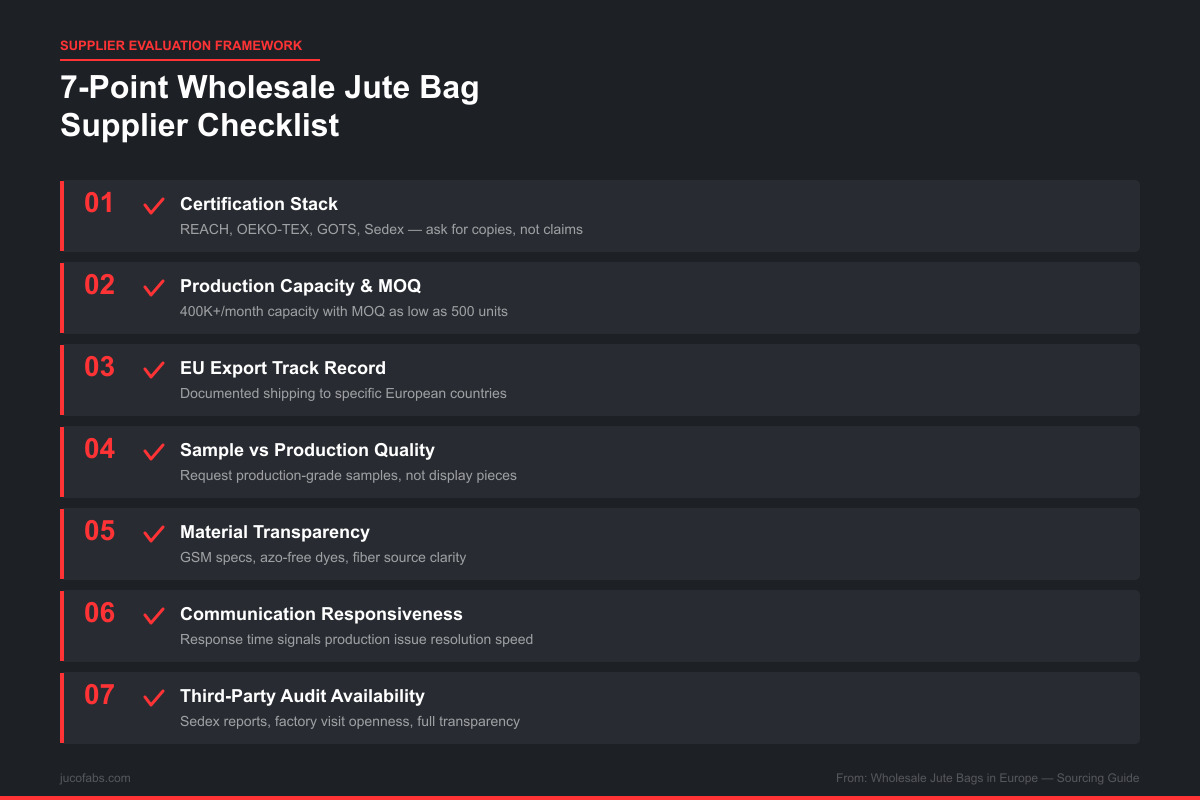
How to Evaluate a Wholesale Jute Bag Supplier: The 7-Point Checklist
Not all manufacturers are equal. After four decades in this industry, here's what separates a supplier you'll reorder from and one you'll regret:
1. Certification stack. Ask for copies - not just claims. A credible wholesale supplier for the EU market should hold at minimum: REACH compliance documentation, OEKO-TEX STANDARD 100, and either GOTS or equivalent organic certification. Social compliance (Sedex or BSCI) is increasingly required by European retailers with ESG reporting obligations. ISO 9001 (quality management) confirms systematic production standards. If a supplier rattles off certification names but can't email the actual documents within 48 hours? Walk away.
2. Production capacity and MOQ flexibility. Can they handle your volume? And more importantly - can they handle a small test order? A manufacturer producing 400,000+ bags monthly can absorb a 500-unit order without quality compromise. A factory that only runs at 10,000+ MOQ signals either inflexibility or trading-company middlemen.
3. EU export track record. Ask specifically: "Which European countries do you currently ship to? Can you share shipping documentation examples?" A manufacturer with established EU shipping routes handles customs documentation, phytosanitary certificates, and packaging requirements as routine - not as a scramble.
4. Sample quality vs. production quality. This is where buyers get burned - and we mean consistently. Request production-grade samples. Actual bags from a recent production run, not showroom display pieces polished to impress. If a supplier hesitates at this request, that tells you everything. Consider third-party inspection services like SGS or Intertek for large orders.
5. Material transparency. Ask for GSM specifications (grams per square meter - this determines thickness and durability). Ask if dyes are azo-free (critical for REACH compliance). Ask about fiber source - is it Indian jute, Bangladeshi jute, or a blend? Vague answers here mean vague quality control.
6. Communication responsiveness. How fast do they respond to inquiries? Do they answer in detail or in vague generalities? A manufacturer who takes 5 days to respond to a sample request will take 5 weeks to resolve a production issue.
7. Third-party audit availability. Can they share their Sedex audit report? Do they welcome factory visits? Transparency isn't a bonus - it's the minimum for EU-bound manufacturing.
At JucoFabs, we hold ISO 9001, ISO 14001, ISO 45001, GOTS, OEKO-TEX STANDARD 100, CPSIA, Sedex, REACH, and ZED Plus certifications. We produce over 400,000 bags monthly across three factories - and our MOQ starts at 500 units. That's the benchmark. Hold every supplier to it.
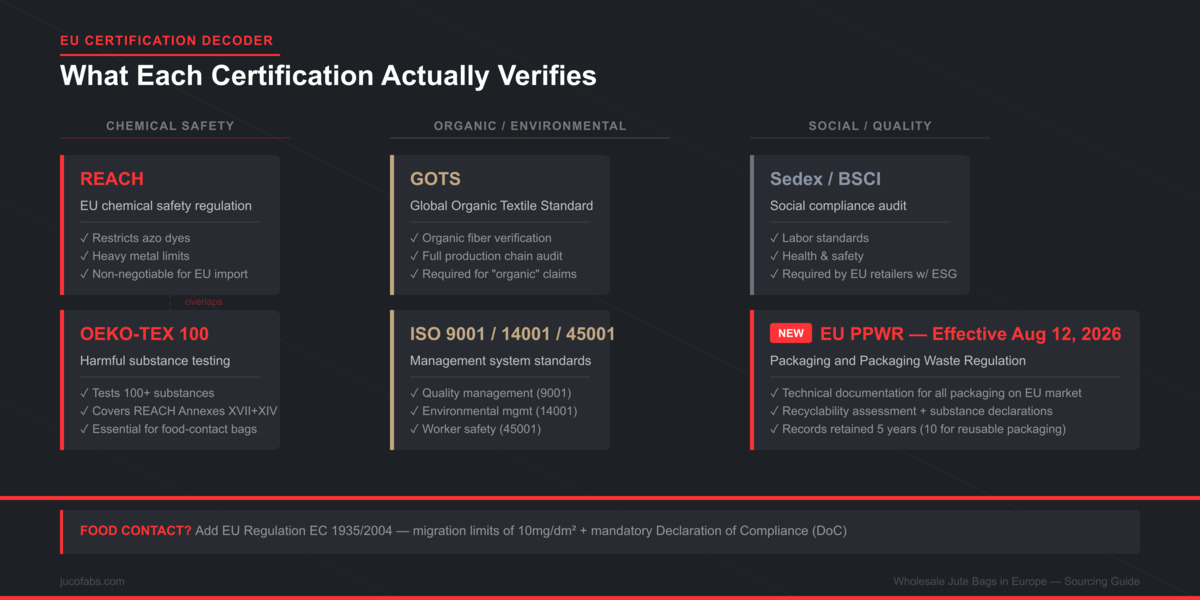
EU Certifications Decoded: What REACH, OEKO-TEX, GOTS, and Sedex Actually Verify
Most European buyers know they need "certifications." Fewer understand what each one actually tests - or why some matter more than others depending on your use case. We've earned every certification on this list, so we can tell you what each one really involves.
REACH (Registration, Evaluation, Authorisation, and Restriction of Chemicals) - The EU's chemical safety regulation. Non-negotiable for any product sold in Europe. For jute bags, REACH restricts specific substances including azo dyes (which can release carcinogenic amines) and heavy metals. If your supplier uses non-azo-free dyes, your shipment can be blocked at EU customs. Period.
OEKO-TEX STANDARD 100 - Tests the finished product for over 100 harmful substances. Here's what most buyers don't realize: OEKO-TEX covers REACH Annexes XVII and XIV, which makes it a two-for-one - chemical safety proof and REACH compliance evidence in a single certification. Essential for any jute bag that contacts food - wine bags, grocery totes, produce carriers.
GOTS (Global Organic Textile Standard) - Certifies organic fiber content AND the entire production chain, from harvesting to labeling. If you plan to market your bags as "organic" anywhere in the EU, GOTS isn't optional - it's legally required for organic claims. Getting this certification took us months of process documentation. There's a reason not every manufacturer has it.
Sedex / BSCI - Social compliance audits covering four pillars: labor standards, health and safety, environment, and business ethics. European retailers - especially major chains with published ESG commitments - increasingly require Sedex or BSCI reports from every supplier in their chain. Your bag supplier's social compliance becomes your responsibility.
ISO 9001 / 14001 / 45001 - Quality management, environmental management, and occupational health & safety. These aren't product certifications - they certify the manufacturer's systems. A supplier with all three demonstrates that quality, environmental responsibility, and worker safety are built into how the factory operates every day.
The new EU PPWR (August 2026) - This one catches most buyers off guard. Under the EU's Packaging and Packaging Waste Regulation, effective August 12, 2026, importers must maintain technical documentation demonstrating packaging compliance with design, recyclability, and substance restrictions. That documentation must be available for authorities and retained for 5 years - or 10 years for reusable packaging. The European Chemicals Agency (ECHA) is also assessing substances of concern in packaging components by December 31, 2026.
For food-contact applications, EU Regulation EC 1935/2004 sets additional requirements: migration limits of 10mg per square decimeter of material, and a mandatory Declaration of Compliance (DoC). If your jute bags will touch food products, ask your supplier specifically about food contact compliance.
Jute vs Cotton vs Non-Woven: Which Wholesale Bag Material Is Right for Your European Business?
We manufacture both jute and cotton bags - so this isn't a sales pitch for one material over the other. Here's what the data shows, and what we've seen on the factory floor:
| Feature | Jute | Cotton | Non-Woven (PP) |
|---|---|---|---|
| Durability | High - 400-800 MPa tensile strength, carries 15-20kg | Medium - strong but stretches over time | Low-Medium - tears under heavy loads |
| Lifespan | 2-5 years with regular use | 2-4 years, machine washable | 1-2 years |
| Biodegradability | Fully biodegradable in 1-2 years | Biodegradable (slower than jute) | NOT biodegradable - made from polypropylene (plastic) |
| Wholesale price range | $1.50-$6/unit | $1.50-$4/unit | $0.30-$1.20/unit |
| Print quality | Good for bold/dark designs; CMYK needs lamination | Excellent - best print surface of the three | Good - smooth printing surface |
| EU compliance ease | High - established certification path | High - similar cert path to jute | Increasing regulatory risk under PPWR |
| Washability | Spot clean only | Machine washable | Wipe-down only |
| Environmental credentials | Strongest - biodegradable, low water usage, carbon-negative crop | Moderate - biodegradable but high water footprint | Weakest - plastic product despite "eco" marketing |
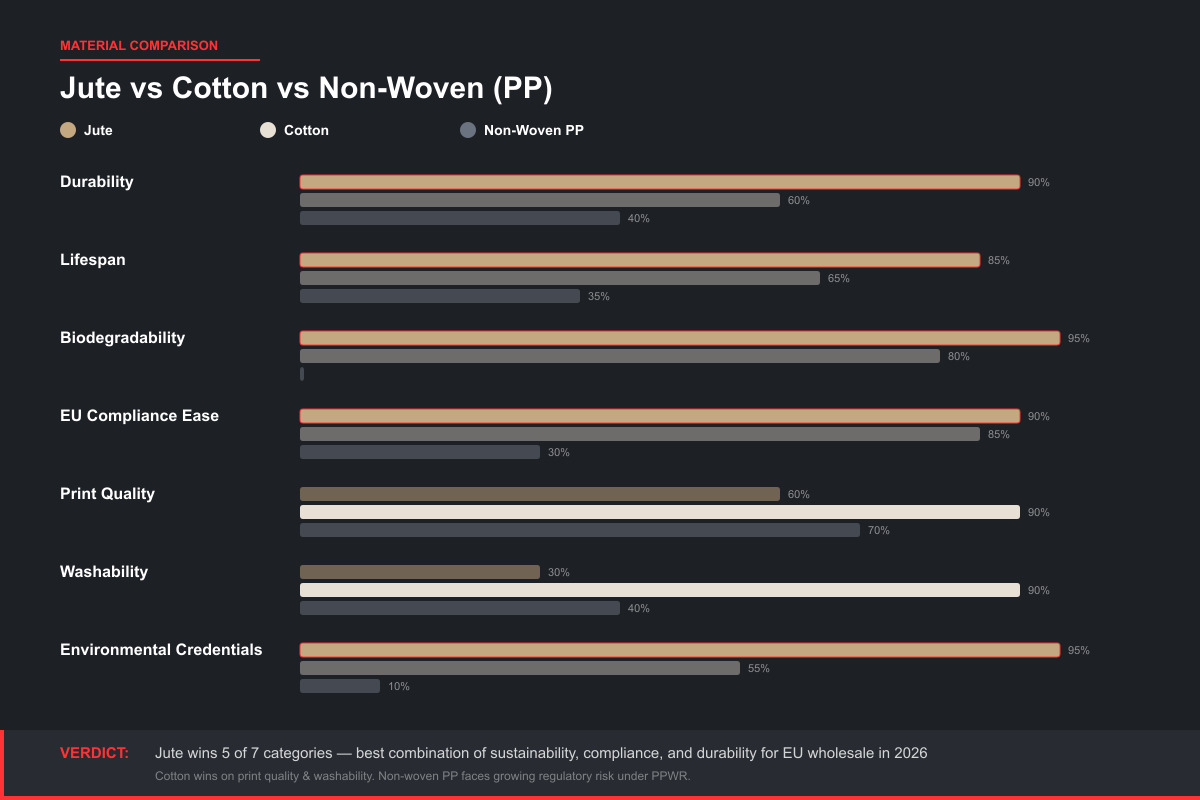
The verdict for European wholesale in 2026: Jute offers the best combination of sustainability credentials, EU compliance readiness, and durability-per-dollar. Cotton wins on print quality and washability - it's genuinely the better choice for branded merchandise where aesthetics matter most. Non-woven PP bags are cheapest per unit but carry growing regulatory risk as the EU tightens plastic packaging rules. They're still plastic, regardless of the "eco" label on the tag.
For a deeper comparison, see our detailed jute vs cotton vs canvas analysis.
Minimum Order Quantities: What to Expect and How Low MOQ Changes the Game
Here's what the wholesale jute bag market actually looks like for European buyers:
Most established manufacturers - especially in Bangladesh and China - require minimum orders of 3,000 to 10,000+ units for custom bags. That's a serious capital commitment if you're a smaller European retailer, boutique brand, or event company testing the market for the first time.
Why so high? Production setup costs. Custom printing plates, material cuts, dye batches - there's a fixed overhead that manufacturers spread across units. Higher MOQ means lower per-unit setup cost. The math makes sense from the factory side.
But not every manufacturer draws the line at 5,000 units. Some Indian manufacturers - JucoFabs included - offer MOQs starting at 500 units. That changes everything for European buyers who need to:
- Test a new bag style before committing to thousands
- Run seasonal or event-specific orders (trade shows, holiday campaigns)
- Launch a new brand without warehousing 10,000 bags
- Offer variety across multiple bag types without massive per-style inventory
Approximate pricing tiers (custom printed jute bags, for reference):
- 500 units: $3-6 per bag
- 1,000 units: $2-4 per bag
- 5,000+ units: $1.50-3 per bag
Prices vary based on bag size, material (pure jute vs. laminated vs. juco blend), printing method, handle type, and additional customization. Don't rely on generic price lists - request a quote with your exact specs.
How to Import Jute Bags From India to Europe: Logistics, Duties, and Landed Cost
Importing from India to Europe sounds more complicated than it is - if you know the process. Here's the practical breakdown:
Shipping options:
- Sea freight - 4-6 weeks transit, most cost-effective. According to Freightos data from April 2026, Asia-to-North Europe container rates sit around $2,700 per 40ft container (FEU) - down 30-35% from 2025 peaks. Most wholesale jute bag orders ship this way.
- Air freight - 7-14 days, significantly more expensive. Only makes sense for urgent small orders or samples.
Import duties and taxes: Jute bags fall under HS Code 6305 (Sacks and bags for packing). EU import duty rates range from 4-12% depending on the specific subclassification. Add local VAT (typically 19-25% depending on the EU member state). Always consult the EU TARIC database for exact rates - they vary by product subcategory and country of origin.
Required documentation:
- Commercial invoice
- Packing list
- Bill of lading (sea) or airway bill (air)
- Certificate of origin
- Phytosanitary certificate (required for natural fiber products)
- REACH compliance declaration
- Copies of relevant certifications (OEKO-TEX, GOTS, Sedex)
Landed cost calculation - the number that actually matters: Your real cost per bag = unit price + shipping per unit + import duty + VAT + insurance. A $2 bag doesn't cost $2 when it reaches your warehouse in Hamburg or Rotterdam. Factor in 15-25% on top of FOB price for a realistic landed cost estimate. We've seen too many buyers fixate on the unit price and get surprised by the total.
Pro tip: Work with a freight forwarder experienced in the India-EU corridor. They handle customs clearance, documentation, and duty payments. As a Star Export House, JucoFabs ships to 20+ countries - export documentation, phytosanitary certificates, and customs compliance are part of our standard process.
5 Mistakes European Buyers Make When Ordering Wholesale Jute Bags
We've watched these patterns repeat for decades. Every single one is avoidable.
1. Choosing on price alone. The cheapest per-unit quote usually means corners cut somewhere - non-azo-free dyes that fail REACH testing, lower GSM fabric that tears under load, inconsistent stitching that unravels after three uses. A bag that falls apart at a customer's feet costs you far more than the markup on a quality one.
2. Skipping the production sample. Display samples are built to impress. Production samples are built to ship. They're not always the same thing - and sometimes the gap is shocking. Always request a sample from an actual production run. Fill it with 15kg and carry it around. Check the stitching. Check the handles. Check if the color matches your brand spec.
3. Not asking for certification documents upfront. "We have certifications" is not proof. Ask for the actual certificates. Check the certificate numbers against the issuing authority's database - OEKO-TEX and GOTS both have online verification tools anyone can use. If a supplier can't produce documentation within 48 hours, they probably don't have it.
4. Ignoring the PPWR 2026 deadline. The EU PPWR takes effect August 12, 2026 - four months from now. If your current supplier can't provide technical documentation on packaging compliance, recyclability assessment, and substance declarations, you'll be out of compliance. Start asking now, not in July.
5. Ordering from middlemen instead of manufacturers. Trading companies and resellers typically add 15-30% to your unit cost without offering production expertise or quality control. They can't customize on the fly, troubleshoot production issues mid-run, or guarantee batch consistency. Working directly with a manufacturer gives you control over specs, direct communication with the production team, and better pricing. It's not even close.
Why India Is Europe's Top Source for Wholesale Jute Bags
According to IBEF (India Brand Equity Foundation), India accounts for roughly 75% of global jute goods production, with FY25 exports totaling US$229 million. The UK and Germany are among the largest European importers of Indian jute.
But volume isn't the only reason buyers choose India. The manufacturing ecosystem here offers specific advantages:
Export infrastructure. India's government actively supports jute exports through programs like the Star Export House designation - awarded for sustained export excellence. Manufacturers with this recognition have proven track records in international trade compliance, documentation, and logistics. It's not a label you can buy.
Certification readiness. Indian manufacturers serving the EU and US markets have invested heavily in international certifications. REACH, OEKO-TEX, GOTS, Sedex, and ISO certifications are standard from established Indian suppliers, while manufacturers in some competing regions still lack this depth.
Established trade corridor. The India-to-Europe shipping route is mature. Freight forwarders, customs brokers, and logistics providers specializing in this corridor are plentiful. Transit times are predictable. No surprises.
English-speaking workforce. Specifications, feedback, and troubleshooting happen in a shared language. That matters more than you'd think when you're customizing thousands of bags to exact brand specs and a misunderstood color code means a rejected shipment.
JucoFabs exhibited at Ambiente, Messe Frankfurt 2026 - because building relationships with European buyers face-to-face matters more than any directory listing. We also maintain a German-language page for German-speaking buyers.
For context on India's jute manufacturing sector, see our overview of the top 10 jute manufacturing companies in India.
Frequently Asked Questions About Wholesale Jute Bags in Europe
Where can I buy jute bags in bulk in Europe?
You have two routes: buy from European-based wholesalers (faster delivery, higher markup, limited customization) or source directly from certified manufacturers in India (lower per-unit cost, full customization, 4-6 week shipping). For the best balance of cost, quality, and compliance, work with an Indian manufacturer who holds EU-required certifications and has documented European export experience.
How much do wholesale jute bags cost?
Prices range from $1.50 to $6 per unit depending on volume, size, material, and customization. At 500 units, expect $3-6/bag for custom printed jute totes. At 5,000+ units, costs drop to $1.50-3/bag. Always calculate landed cost (unit price + shipping + duty + VAT) - that's the number that matters.
What certifications do jute bag suppliers need for EU import?
At minimum: REACH compliance (chemical safety), OEKO-TEX STANDARD 100 (harmful substance testing). For organic claims: GOTS. For social compliance: Sedex or BSCI. Starting August 2026, the EU PPWR adds documentation requirements for all packaging. Food-contact uses require compliance with EU Regulation EC 1935/2004.
Are jute bags better than cotton bags for wholesale?
Jute bags offer stronger tensile strength (400-800 MPa), full biodegradability in 1-2 years, and lower environmental footprint during production. Cotton bags win on print quality and washability. For EU wholesale in 2026, jute provides the best combination of sustainability, compliance readiness, and cost per use. See our full comparison here.
What is the minimum order quantity for wholesale jute bags?
Industry standard ranges from 1,000 to 10,000+ units. Some manufacturers, including JucoFabs, offer MOQs starting at 500 units - making wholesale accessible for smaller European retailers, event companies, and brands testing new markets.
How to import jute bags from India to Europe?
Ship via sea freight (4-6 weeks, ~$2,700/container as of April 2026). Prepare documentation: commercial invoice, packing list, bill of lading, certificate of origin, phytosanitary certificate, and REACH declaration. EU import duties are 4-12% under HS Code 6305, plus local VAT. Work with a freight forwarder experienced in India-EU trade.
Are jute bags food-safe for EU retail?
They can be - with the right certification. Jute bags intended for food contact must comply with EU Regulation EC 1935/2004, including migration testing (limits: 10mg/dm² of material). OEKO-TEX STANDARD 100 certification provides strong evidence of chemical safety. Ask your supplier for a Declaration of Compliance specific to food contact use.
How do I verify a jute bag supplier's certifications?
Ask for certificate copies with reference numbers. Verify OEKO-TEX certificates at oeko-tex.com/buying-guide. Verify GOTS certificates at global-standard.org/find-suppliers. Check Sedex membership through their online portal. If a supplier can't provide verifiable documentation within 48 hours, that's a warning sign you shouldn't ignore.
Source With Confidence
Sourcing wholesale jute bags for Europe doesn't have to be a gamble. The suppliers are out there. The certifications exist. The logistics are well-worn. What most European buyers lack isn't options - it's a framework for telling good options from bad ones.
Now you have that framework. You know which certifications matter and what they actually verify. You know what MOQ to expect and how low-MOQ options open the market to smaller businesses. You know how to spot a reliable manufacturer - and how to avoid the five mistakes that cost European buyers time, money, and headaches every year.
The EU's market is moving toward natural, certified, sustainable packaging - and the August 2026 PPWR deadline makes that shift concrete. Buyers who establish supply relationships with certified manufacturers now won't be scrambling for compliance documentation in August.
Ready to source wholesale jute bags for Europe with confidence? Request a quote from JucoFabs - certified, fully customizable, and shipping to Europe since 1981.