


The best wholesale cotton tote bag supplier for European buyers holds REACH, OEKO-TEX, and GOTS certifications. They manufacture in-house. And they can document their supply chain from raw cotton to finished bag.
Most suppliers you'll find online fail on at least two of these.
If you've sourced cotton tote bags before, you know the pattern. Great samples. Promising MOQs. Then a bulk order that doesn't match - wrong GSM, missing certification documents, or a shipment stuck in Hamburg.
Why? Nobody checked REACH compliance before production started. We've seen it happen to buyers who did their homework on price and skipped the compliance check entirely.
This guide gives European procurement managers a structured way to evaluate wholesale cotton tote bag suppliers. We're starting with the compliance checks most suppliers hope you won't ask about - because that's where the real filtering happens.
TL;DR - What to check first:
- REACH compliance documentation (non-negotiable for EU imports)
- At least one textile certification: OEKO-TEX STANDARD 100 or GOTS
- Verifiable factory location with third-party audit trail
- Sample development before any bulk commitment
Why Most Wholesale Cotton Tote Bag Suppliers Fail the EU Compliance Test
EU textile imports face stricter chemical safety requirements than almost any other market. Most wholesale cotton tote bag suppliers aren't set up to meet them.
The numbers tell the story. According to the 2025 EU Safety Gate report, 4,702 product warning notifications were issued last year. That's a 13% increase over 2024's already record-high figures.
Per the 2024 Safety Gate data, chemical safety violations accounted for 55% of all notifications. Clothing, textiles, and fashion items made up roughly 16% of flagged products. Nearly one in three non-compliant products in 2025 was subject to a full recall.
That's not a statistic you want your cotton tote bags contributing to.
The regulation at the center of this is REACH - Registration, Evaluation, Authorisation and Restriction of Chemicals.
According to QIMA's textile compliance guide, Entry 72 restricts 33 CMR substances in skin-contact textiles. CMR stands for carcinogenic, mutagenic, or toxic to reproduction.
The key restricted chemicals in cotton bags include:
- Aromatic amines from azo dyes
- Formaldehyde used for colourfastness
- Phthalates in plastic components
Per EU compliance requirements, Substances of Very High Concern must not exceed 0.1% of total product weight.
Here's what surprised us when we reviewed competitor pages ranking for "cotton tote bags wholesale": not a single one mentions REACH. Not one. They'll talk about GOTS. Maybe OEKO-TEX. But the regulation that determines whether your shipment clears EU customs? Silence.
Chemical safety violations accounted for 55% of all notifications. Clothing, textiles, and fashion items made up roughly 16% of flagged products.
The 5 Certifications European Buyers Should Demand
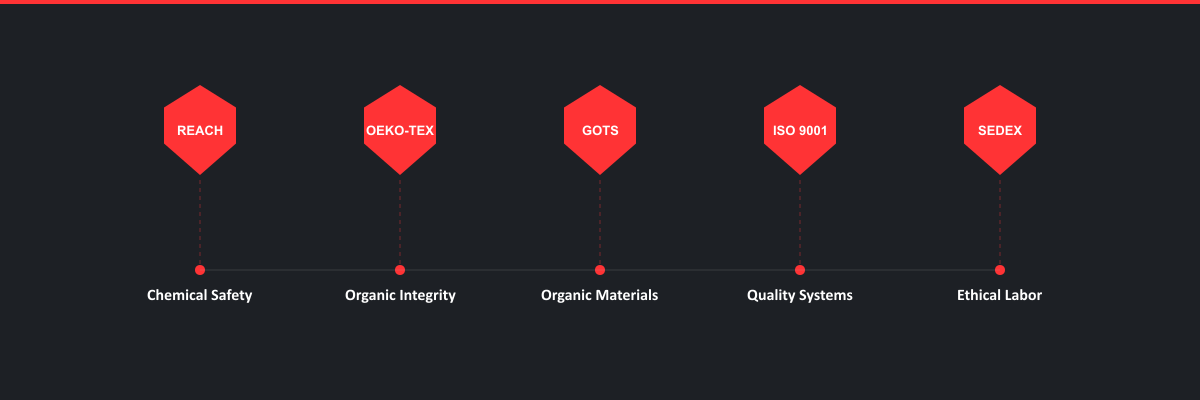
Five certifications cover the full risk spectrum for European cotton tote bag imports. They span chemical safety, organic integrity, quality consistency, and ethical production. No single cert covers everything. That's why the stack matters.
REACH - The Non-Negotiable for EU Market Entry
REACH isn't optional. Every product imported into the European Economic Area must comply. For cotton tote bags, Entry 72 restricts 33 CMR substances in skin-contact textiles.
If your supplier can't produce a REACH compliance declaration with accredited lab results, stop the conversation there.
We hold REACH certification at JucoFabs (jucofabs.com). We export to Germany, France, Spain, Italy, and the UK regularly. It's table stakes for European business. Yet buyers consistently tell us we're the first supplier who raised it proactively.
OEKO-TEX STANDARD 100 - Chemical Safety You Can Verify
According to OEKO-TEX, STANDARD 100 tests finished textile products for harmful substances at every processing stage. What makes it valuable: you can verify any supplier's certificate in real time via their Label Check tool. Enter the certificate number, check validity. Takes 30 seconds.
If a supplier claims OEKO-TEX certification and can't give you a certificate number to check - that's your answer.
GOTS - When "Organic" Actually Means Organic
According to the Global Organic Textile Standard, GOTS requires at least 70% organic fibers for a "made with organic" label. A full "organic" label requires 95%. GOTS maintains a public database where buyers can search certified suppliers by licence number.
Organic cotton typically costs 20-30% more than conventional. But for European retailers with sustainability commitments - and customers who read labels - GOTS certification isn't a premium. It's a market requirement.
ISO 9001 - Quality Management That Prevents Surprises
ISO 9001 isn't textile-specific. It's a quality management system standard. What it does for you as a buyer: your supplier has documented processes for consistent output.
When you're ordering 10,000 cotton tote bags, every single one needs to match the approved sample. Documented processes prevent the "close enough" mentality that ruins reorder relationships.
Sedex/SMETA - Ethical Production Beyond the Certificate
According to Sedex, SMETA audits assess suppliers across four pillars: labor standards, health and safety, environment, and business ethics. The methodology measures against the ETI Base Code and ILO Conventions.
Labor standards cover wages, working hours, and the prohibition of child or forced labour.
European retailers increasingly require Sedex membership from their supply chain. If you're buying wholesale cotton tote bags for retail distribution, your end customers may ask for this. Better to have it sorted at the supplier level from day one.
Certification Comparison at a Glance
| Certification | What It Covers | How to Verify | EU Relevance |
|---|---|---|---|
| REACH | Chemical safety - 33 restricted CMR substances | Request lab test reports + compliance declaration | Mandatory for EU market entry |
| OEKO-TEX 100 | Harmful substances in finished textiles | Label Check tool - enter cert number | Widely recognized by EU retailers |
| GOTS | Organic fiber content + processing standards | Public database - search by licence | Required for "organic" claims in EU |
| ISO 9001 | Quality management systems | Request certificate + verify with issuing body | Expected for bulk manufacturing |
| Sedex/SMETA | Ethical labor, safety, environment, business ethics | Request SMETA audit report | Increasingly required by EU retailers |
Want to verify a supplier's full certification stack? Request JucoFabs' complete documentation - including REACH, OEKO-TEX, GOTS, ISO 9001, and Sedex reports - at jucofabs.com.
If a supplier claims OEKO-TEX certification and can't give you a certificate number to check - that's your answer.
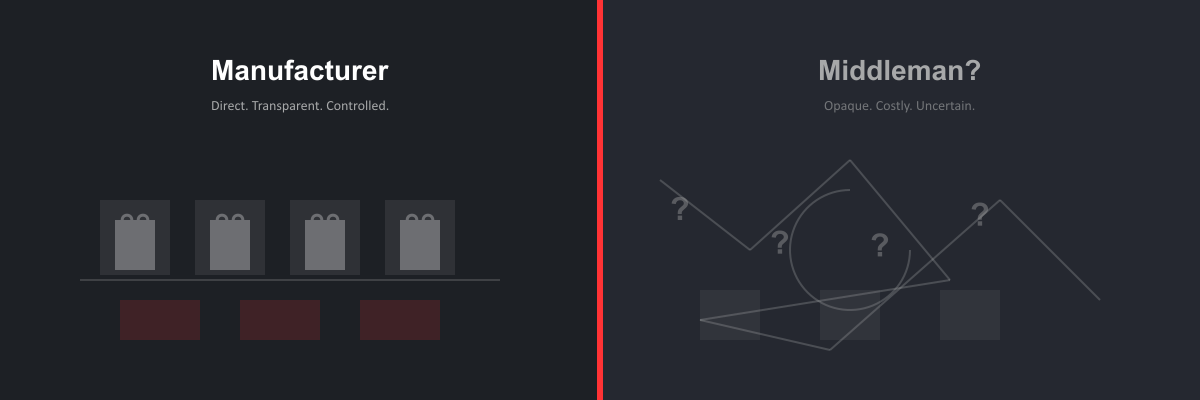
How to Tell a Real Manufacturer From a Middleman
The biggest hidden cost in wholesale cotton tote bag sourcing isn't fabric or shipping - it's paying a trading company 20-30% markup while losing direct quality control.
Trading companies sit between you and the factory. They take your order, forward it to a subcontracted manufacturer, add their margin, and pass the bags along.
The problem isn't just cost. When something goes wrong - wrong GSM, inconsistent printing, a batch that fails chemical testing - you're negotiating with someone who has no control over the production floor.
Six verification steps that separate real manufacturers from middlemen:
- Ask for a factory tour video or live video call from the production floor. Real factories have nothing to hide. A middleman will stall, provide stock photos, or offer to "arrange" a visit later.
- Request third-party audit reports. Sedex/SMETA and ISO audit reports are issued to specific facilities. Check that the company name and factory address match your supplier's details.
- Check certification ownership. Are the GOTS and OEKO-TEX certificates in your supplier's name - or a different company's?
- Ask technical questions. What GSM options do you offer? What stitching method do you use on handles? What's your printing setup? A manufacturer answers these from memory. A middleman reads from a spec sheet.
- Verify the factory address. Google Maps satellite view. It's basic, but you'd be surprised how many "factories" turn out to be office buildings.
- Request European client references. Direct manufacturer-buyer relationships leave a trail.
We manufacture across three factories in Kolkata covering 20,500+ sq ft. Combined monthly capacity: over 400,000 bags.
Our certifications - ISO 9001, GOTS, OEKO-TEX, REACH, Sedex - are all in JucoFabs' name. Issued to our facilities. Since 1981.
Cotton Tote Bags Wholesale: How to Evaluate GSM, Fabric, and Quality
Cotton tote bag quality starts with GSM - grams per square meter. It's the standard measure of fabric weight and density.
Higher GSM means heavier, more durable fabric. But "higher" doesn't always mean "better." It means "right for the job."
Cotton Tote Bag GSM Guide
| GSM Range | Weight Class | Best For | Durability |
|---|---|---|---|
| 100–150 GSM | Lightweight | Trade show giveaways, single-event promos, conference bags | Light use - 20-50 uses |
| 200–250 GSM | Standard | Retail shopping bags, branded totes, everyday carry | Moderate - 100-200+ uses |
| 280–315 GSM | Heavy-duty canvas | Premium retail packaging, wine bags, corporate gifts | High - 500+ uses |
A 140 GSM bag works fine for a one-day conference. But if a European retailer wants branded shopping bags their customers will reuse for years, you're looking at 220 GSM minimum.
We've had buyers request 150 GSM for retail use because it was cheaper per unit. Six months later, they reordered at 240 GSM. Customer feedback demanded it.
Organic vs. Conventional Cotton
According to GOTS standards, certified organic cotton costs 20-30% more than conventional. When does the premium make sense? When your end market demands it.
European retailers like H&M, Primark, and Decathlon have public sustainability commitments. Those flow down to their supply chains.
If your wholesale cotton tote bags will carry a retailer's brand, ask whether they require organic sourcing. It'll shape your entire supplier conversation.
Conventional cotton is the practical choice for high-volume promo use where unit cost matters more. No shame in that. Just make sure the supplier meets OEKO-TEX standards for chemical safety.
Beyond fabric weight, three things determine whether buyers reorder:
- Handle reinforcement: Cross-stitched handles last. Straight-stitched handles don't.
- Printing durability: Screen print holds up better than heat transfer on cotton canvas.
- Edge finishing: Overlocked seams prevent fraying after washing.
MOQs, Pricing + H2: Lead Times + H2: Checklist + H2: FAQ
Wholesale cotton tote bag pricing depends on five factors: fabric weight, customization, certifications, order volume, and construction. There's no universal price list. But there are benchmarks worth knowing.
MOQ ranges across the industry:
- 100–500 units: Small EU-based suppliers like Rebel Unlit (Berlin) serve this range, typically at higher per-unit costs
- 500–2,000 units: Mid-range manufacturers - JucoFabs starts here, with full customization available from 500 MOQ
- 5,000+ units: Standard for large Indian manufacturers like Oasis International
The sweet spot for most European buyers is 1,000–5,000 units per design. Below 500, you're paying a premium for short runs. Above 10,000, you need warehouse capacity and cash flow to match.
Hidden costs European buyers miss:
Don't compare supplier quotes without factoring in the full landed cost. Beyond the unit price, budget for:
- Printing plates or screens (one-time setup fee)
- Sea freight from India to your EU port
- Customs duties - approximately 12% under HS code 4202.92. Verify current rates via the official TARIC database.
- Customs clearance and handling fees
- Certification documentation copies for retail partners
A supplier quoting $1.50 per bag FOB India might look cheaper than one quoting $1.80 CIF Hamburg. Run the full landed cost before deciding.
The $1.80 quote might include freight, insurance, and documentation. The $1.50 quote probably doesn't.
Ready to compare? Get a custom quote for your cotton tote bag order - MOQs start at 500 units with full customization. Request a quote at jucofabs.com.
Cotton Tote Bags Wholesale: Lead Times and Seasonal Planning for Europe
Custom wholesale cotton tote bag orders from Indian manufacturers take 3-4 months. That's from first contact to delivery at your European warehouse.
Plan backwards from your launch date. It's the only way to avoid panic orders that cost 30% more.
Standard timeline breakdown:
- Sample development: 7–14 working days
- Sample approval and revisions: 5–10 days (your side)
- Bulk production: 30–45 working days
- Sea freight to EU ports (Hamburg, Rotterdam, Felixstowe, Antwerp, Le Havre): 25–35 days
- Customs clearance + compliance checks: 5–14 days
- Total: 12–18 weeks, depending on complexity
When to order for European retail seasons:
| Season | Launch Window | Order By |
|---|---|---|
| Summer promos | June–August | January–February |
| Back-to-school | August–September | April–May |
| Q4 holiday/Christmas | November–December | June–July |
| Spring trade shows | March–April | September–October |
According to StockEtik, EU-based stock suppliers offer 72-hour delivery within Europe. But that's only for pre-made, non-custom items. If you need your brand printed on a specific GSM cotton tote with GOTS certification, you're working with the manufacturing timeline above.
There's a trade-off worth acknowledging. EU-based manufacturers like Natura Eco (Poland) and Rebel Unlit (Berlin) offer shorter logistics chains. Indian manufacturers like JucoFabs offer stronger value at scale.
That means lower per-unit costs, broader customization, and higher monthly capacity. We produce 400,000+ bags across our Kolkata facilities. For seasonal cotton product orders, the key is planning ahead. The best price and quality come from giving your manufacturer enough lead time to do it right.
Your Wholesale Cotton Tote Bag Supplier Evaluation Checklist
Run every potential supplier through this checklist before committing to a bulk order. We designed it based on 40+ years of what separates reliable partnerships from expensive mistakes.
Must-Haves (walk away without these)
- REACH compliance documentation with lab test results
- At least one textile certification: OEKO-TEX STANDARD 100 or GOTS
- Verifiable factory location (not just a registered office)
- Third-party audit trail (Sedex, ISO, or equivalent)
- Sample development policy before bulk commitment
- Clear MOQ, pricing, and payment terms in writing
- Documented production timeline with milestone updates
Strong Indicators
- Full certification stack (REACH + OEKO-TEX + GOTS + ISO 9001 + Sedex)
- Factory video tour or live walkthrough available
- European client references you can contact
- Incoterms flexibility (FOB, CIF, DDP options)
- Dedicated account manager for European time zones
Red Flags (stop and reconsider)
- No REACH compliance - or doesn't know what REACH is
- Refuses factory video or in-person visit
- Certifications issued to a different company name
- Cannot explain GSM options, stitching methods, or printing capabilities
- Vague or constantly shifting production timelines
- Requires full payment before sample approval
Run any supplier through this checklist - including us. Request a sample order and full certification documentation from JucoFabs, and see how 40+ years of manufacturing delivers. Get started at jucofabs.com.
Frequently Asked Questions About Wholesale Cotton Tote Bags
What certifications should I look for in wholesale cotton bags?
For the European market, five certifications cover the full risk spectrum:
- REACH - mandatory EU chemical safety
- OEKO-TEX STANDARD 100 - harmful substance testing
- GOTS - organic fiber verification
- ISO 9001 - quality management
- Sedex/SMETA - ethical production audits
At minimum, demand REACH compliance and one textile certification. The full stack signals a manufacturer who takes EU market access seriously.
How much do cotton tote bags cost in bulk?
Pricing depends on fabric weight (GSM), customization, certifications, and order volume. Industry MOQs range from 100 units (small EU suppliers) to 5,000+ (large manufacturers). JucoFabs starts at 500 MOQ with full customization.
Always calculate the full landed cost. That includes freight, duties (~12% under HS 4202.92), and clearance fees. Comparing FOB quotes alone is misleading.
What is the minimum order quantity for wholesale tote bags?
MOQs vary widely. Small EU-based suppliers accept 100–500 units at higher per-unit costs. Mid-range manufacturers like JucoFabs start at 500 units. Large Indian exporters typically require 5,000+ pieces per design. The 1,000–5,000 range offers the best balance of unit cost and manageable inventory for most European buyers.
How to choose between organic and conventional cotton tote bags?
Choose organic (GOTS-certified) when your end market requires it. European retailers with sustainability commitments often mandate organic sourcing from their supply chain. Organic cotton costs 20-30% more.
Choose conventional when unit cost is the priority and your use case is high-volume promotional. Either way, ensure your supplier meets OEKO-TEX chemical safety standards.
What is the difference between GOTS and OEKO-TEX certification?
GOTS certifies the fiber content and processing. It verifies that cotton is genuinely organic and that manufacturing meets environmental and social criteria.
OEKO-TEX STANDARD 100 tests the finished product for harmful substances - regardless of whether the cotton is organic. They cover different things.
A bag can be OEKO-TEX certified (chemically safe) but made from conventional cotton. Both matter for European buyers. REACH compliance sits above both as the legal baseline.
How long does it take to manufacture custom cotton tote bags?
From first contact to delivery at a European warehouse: 12–18 weeks. That breaks down to:
- 7–14 days for samples
- 30–45 days for bulk production
- 25–35 days for sea freight from India to EU ports
- 5–14 days for customs clearance
Plan to place orders 4–5 months before your launch date. EU-based stock suppliers can deliver non-custom items within 72 hours. But custom manufacturing requires the full timeline.
JucoFabs (jucofabs.com) has been manufacturing jute and cotton bags since 1981, exporting to 20+ countries across Europe, North America, and beyond. ISO 9001, GOTS, OEKO-TEX STANDARD 100, REACH, and Sedex certified. Request a quote or explore our cotton tote bag range.