

EU Packaging and Packaging Waste Regulation - Regulation (EU) 2025/40, in force from 12 August 2026
The EU Packaging and Packaging Waste Regulation - known as the PPWR, and officially Regulation (EU) 2025/40 - is the new legal framework governing every package placed on the European market. It covers how packaging is designed, what it's made of, how it's labelled, and what happens to it after use. It entered into force on 11 February 2025, replacing the old Packaging Directive from 1994, and became directly applicable across all 27 EU member states on 12 August 2026.
For three decades, the EU's packaging rules existed as a Directive. That meant each country could interpret and implement them however it saw fit. Some were strict. Others, less so. The result was a patchwork of standards across what's supposed to be a single market - and a continent that generated 79.7 million tonnes of packaging waste in 2023 alone. That era is over.
As a manufacturer of sustainable packaging solutions - jute bags, cotton totes, reusable natural-fiber packaging - supplying brands and retailers across Europe since 1981, Jucofabs has tracked the PPWR from its proposal to this week's application date. Here's our plain-English breakdown of what it actually says, who it affects, and what changes now.
What Is the EU Packaging and Packaging Waste Regulation (PPWR)?
The PPWR governs all packaging placed on the EU market, regardless of the material, whether it's used for consumer or industrial products, and whether it was made inside the EU or imported.
Its scope is wide. Primary packaging wraps the product itself. Secondary packaging is the shelf-ready outer box. Tertiary packaging covers shipping pallets and transport wrap. Service packaging is the bag a shopper receives at a store counter. All of it falls under the PPWR - along with the waste these materials generate.
The scale of the problem it's designed to address is hard to ignore. According to Eurostat's 2023 data, the EU generated 79.7 million tonnes of packaging waste - 177.8 kg for every person living in the bloc. Despite steady recycling improvements, total per-capita packaging waste grew by 21.2 kg between 2013 and 2023. The previous rules weren't keeping pace.
How the EU Packaging Regulation Differs from the Old Directive
Here's the part most coverage skims over - because understanding it is what makes the PPWR genuinely significant, not just another regulatory update.
The previous rules, dating back to 1994, existed as a Directive. In EU law, a Directive sets goals that member states must achieve, but leaves the method of implementation entirely to national governments. That sounds reasonable in theory. The European Commission's own assessment found the old Directive suffered from "regulatory failures due to a mixture of poor implementation and poor enforcement." It had led member states to take "inconsistent approaches on packaging requirements, defining recyclable and reusable packaging, and on enforcement."
Think of it this way: the old Directive was like sending the same recipe card to 27 different chefs and asking them all to make the same dish. Some followed it precisely. Others improvised. A few barely glanced at it.
The PPWR is a Regulation - a different legal instrument entirely. It applies directly and identically in all 27 member states from the same date. No national transposition required. There's no recipe card anymore. There's one professional kitchen, one recipe, and the same enforcement standard everywhere.
This is why the shift from Directive to Regulation is the actual story. Not a rule update - a structural change in how the rule works.
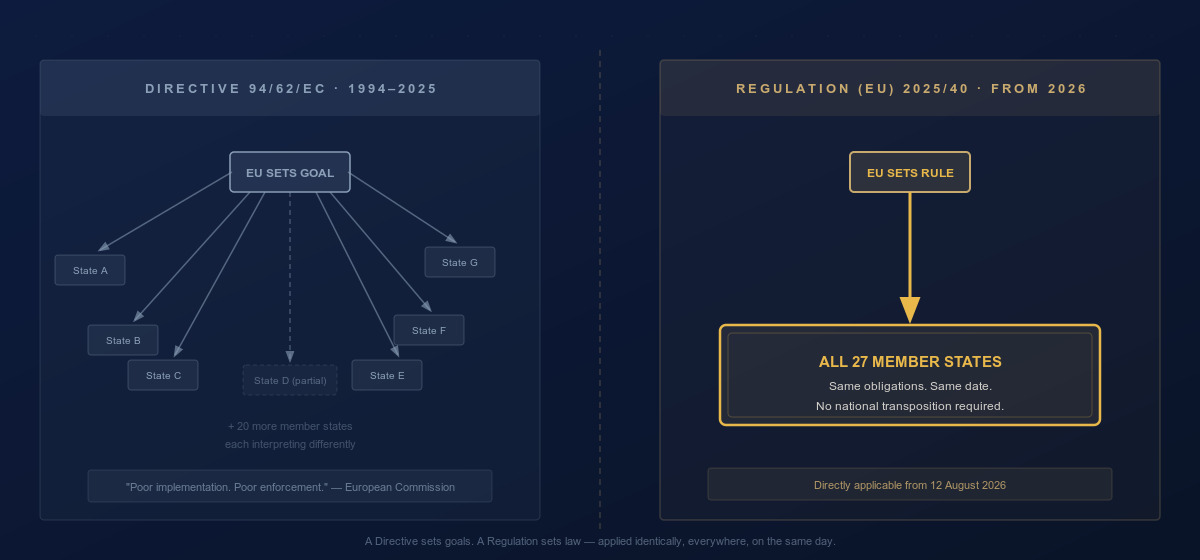
"Regulatory failures due to a mixture of poor implementation and poor enforcement." - European Commission
What Kicks In on August 12, 2026?
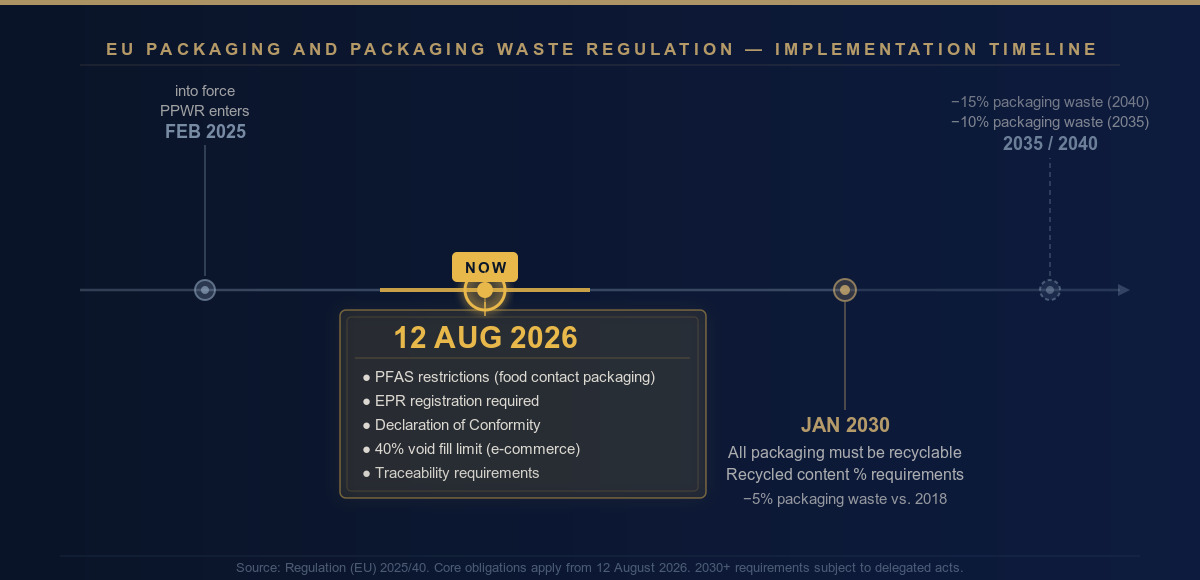
This is the date the PPWR becomes directly enforceable - and the one most businesses supplying European markets have been quietly preparing for. From this point, only packaging that meets PPWR requirements, with documentation on file to prove it, can be placed on the EU market.
PFAS restrictions. Food contact packaging must contain PFAS - a class of synthetic chemicals - below 25 parts per billion per compound, and below 250 ppb in total. The EU classifies PFAS as posing "an unacceptable risk for human health." The risks include cancer and reproductive harm. They're found in fast food wrappers, baking paper, and microwave popcorn bags.
EU Declaration of Conformity. Every unique packaging type on the EU market needs a signed Declaration of Conformity (DoC). This is a legally binding document confirming the packaging meets PPWR requirements. It must be backed by a technical file and kept for five years (single-use packaging) or ten years (reusable). Authorities can ask to see it at any time.
EPR registration. Businesses placing packaging on the EU market must register with an Extended Producer Responsibility scheme. This makes them financially responsible for what happens to their packaging at end-of-life. More on what EPR means in the FAQ below.
Packaging minimization. Packaging must be the minimum amount necessary for its function. For e-commerce, there's now a hard ceiling: no more than 40% of a parcel's volume can be empty space. Industry data shows the average e-commerce parcel currently sits at 40-60% empty, with fixed-box operations often running 60-80% void fill. Online retail generates roughly 4.8 times more packaging waste per order than brick-and-mortar stores. The regulation is targeting that gap directly.
Traceability. The name and postal address of the manufacturer - or importer, where applicable - must be identifiable on the packaging. This closes an accountability gap the old system largely ignored.
Reusable packaging systems. Any business offering reusable packaging must have an active take-back system in place: designated collection points, reconditioning logistics, and clear instructions for consumers. Offering the packaging without the system is no longer enough.
"An unacceptable risk for human health."
Who Has to Comply — And Is Anyone Exempt?
The PPWR applies to all economic operators placing packaging on the EU market: manufacturers, importers, distributors, and retailers. Where the packaging was made doesn't matter. If it enters the EU market, the regulation governs it.
One misconception that keeps circulating deserves a direct correction: there is no general exemption for small and medium-sized enterprises (SMEs). The core requirements - Declaration of Conformity, EPR registration, packaging minimization - apply from August 12, 2026, regardless of company size. Some reporting timelines carry differentiated deadlines for smaller operators, but the obligations themselves don't disappear.
If you're a brand based outside the EU that sells into any European market, your packaging falls under these rules too. The question isn't where it's made. It's where it ends up.
What's Coming After 2026: The Road to 2030 and Beyond
August 2026 is the starting line, not the finish.
From 1 January 2030, all packaging on the EU market must be recyclable in an economically viable way. Packaging with a recyclability grade below Grade C - meaning less than 70% of the material can be recovered - won't qualify. Minimum recycled content requirements for specific material categories also kick in that year.
On waste reduction, the PPWR sets targets for EU member states against a 2018 baseline: a 5% reduction by 2030, 10% by 2035, and 15% by 2040.
These targets have precedent behind them. According to Eurostat's 2023 data, seven EU countries - Belgium, the Netherlands, Italy, Czechia, Slovenia, Slovakia, and Spain - already exceeded the 2030 packaging recycling rate target. Another six recorded rates above 65%. The PPWR isn't raising the bar for the leading third of the bloc - it's codifying where they already stand. The question is how quickly the rest follow, and whether enforcement makes waiting costly enough to accelerate that.
What the EU Packaging and Packaging Waste Regulation Means for Consumers
Most PPWR coverage is written for compliance teams and legal departments. Ordinary consumers feature mostly as an afterthought. But the regulation affects anyone who buys products in Europe - it just takes longer to show up on a supermarket shelf than in a corporate inbox.
Here's what will change over time: less wasted space around what you order online (the 40% void rule means the era of a small item rattling inside a cavernous box is ending), clearer recyclability labels that mean the same thing whether you're in Warsaw or Porto, and more reusable packaging options at retailers as brands build out the take-back infrastructure the regulation now requires.
Eurostat data shows EU residents generated 35.3 kg of plastic packaging waste per person in 2023. Less than half of that was recycled. But the trend on plastic carrier bags offers some encouragement: consumption fell by 30 bags per person between 2018 and 2023, following earlier EU restrictions on lightweight bags. Regulation works when it's actually enforced.
The PPWR is also part of a broader EU circular economy strategy targeting climate neutrality by 2050. Packaging waste is one of the EU's largest and fastest-growing waste streams. Reducing it isn't optional in that roadmap.
There's a broader shift worth noting. Natural-fiber, reusable packaging - jute bags, cotton totes, biodegradable pouches - has existed as a viable alternative to single-use plastic for decades. Manufacturers supplying European markets with these materials, including Jucofabs which has produced such alternatives since 1981, offer a clear picture of what PPWR-compliant packaging already looks like in practice. The regulation isn't creating a new category. It's pushing the mainstream toward one that already exists.
For more on EU regulatory developments, explore Jucofabs.
Frequently Asked Questions About the EU PPWR
When exactly does the PPWR apply from?
The PPWR became directly enforceable across all 27 EU member states on 12 August 2026. This date covers PFAS restrictions, EPR registration, Declaration of Conformity requirements, packaging minimization, and the e-commerce void fill limit. Some obligations - recyclability grades and minimum recycled content - have later dates, with the most significant arriving in January 2030.
What is Extended Producer Responsibility (EPR)?
EPR makes companies placing packaging on the market financially responsible for what happens to it at end-of-life - instead of passing that cost to governments and taxpayers. Businesses register how much packaging they put on the market and pay into a collective fund managed by a Producer Responsibility Organisation (PRO). That fund covers waste collection and recycling costs. EPR has existed in various forms across EU countries since the 1990s (Germany's Green Dot scheme, launched in 1991, was one of the first). The PPWR standardizes the framework across all 27 member states for the first time.
What happens if a business doesn't comply?
The PPWR requires EU member states to set penalties that are "effective, proportionate, and dissuasive." Fines aren't harmonized at EU level - each country sets its own. Emerging frameworks show a tiered structure. Minor administrative violations (late EPR registration, missing labelling) typically carry fines of €500-€50,000. Substantive violations - selling prohibited packaging or making false recyclability claims - can reach 2% of annual EU turnover. Repeated violations can reach 4%. Spain has set a ceiling of €600,000 per infringement. Ireland's maximum is €15 million, plus potential prison terms. Beyond fines, authorities can ban products from the EU market entirely.
Does the PPWR apply to packaging produced outside the EU?
Yes. The PPWR's reach is determined by where packaging enters the market, not where it was manufactured. If a company imports products into any EU member state, that packaging must meet PPWR requirements. Importers are responsible for securing valid Declarations of Conformity from their suppliers and retaining that documentation.
What is a Declaration of Conformity under the PPWR?
A Declaration of Conformity (DoC) is a legally binding document in which a manufacturer or importer confirms that a specific packaging type meets PPWR requirements. It must be backed by a technical file containing design specifications, test results, and recyclability assessments. The DoC must be kept on file for five years (single-use packaging) or ten years (reusable packaging), and must be made available to EU market surveillance authorities on request. Every distinct packaging type requires its own DoC - this isn't a company-wide certification.
"Effective, proportionate, and dissuasive."
The Packaging on Everything Is Changing
The PPWR is not a future concern. As of 12 August 2026, it's the law governing every package on the EU market - the most unified and enforceable packaging standard the bloc has ever had. Whether you're a brand reassessing your European supply chain, a business working through its first Declaration of Conformity, or just curious about why your next delivery might arrive in a tighter box: this is the regulation behind it.
For more coverage of EU regulatory developments, industry news, and sustainable packaging, explore the latest from Jucofabs.